The Thingness of the Thing
Robin Klassnik, Director, Matt’s Gallery, invited me to write a text for Richard Grayson’s publication By Our Own Hand, an embroidery project involving Wandsworth residents. In the essay below, I discuss embroidery as a form of protest, labour movements, social mores and the sculptural nature of stitching.
When Lorina Bulwer was interned in a Great Yarmouth workhouse in 1894 until her death fifteen years later, she was classified as a lunatic. She made protest embroideries to express anger at her incarceration. In a series of exquisitely produced lengthy texts, she rails against falsehood, men, taxes, flea-bag tribes, eunuchs and hermaphrodites, the French, bastards, tramps and hawkers, anarchists, nihilists, whores, traitors and bad onions. One particularly fine diatribe is aimed squarely at her sister-in-law who is deemed to be false in every way: FALSE NOSE, FALSE TEETH, FALSE HAIR, ENAMELED HANDS, FALSE FEET, STUMP LEGS, FALSE CHEST.
Embroidery and text are an incredibly effective way of announcing one’s place in the world. I’m standing, looking at Bulwer’s work at Norwich Castle Museum. There is a palpable sense of a defiant declaration: “I exist! I will not be silenced.” It is beautiful, rich, strange, disturbing and wildly unique. The format of the two-metre-long, twenty-centimetre-wide invective is dictated by the material conditions under which it was made: the workhouse received donations of cheap fabric, and the violent red used throughout is flannel from inmates’ petticoats. The scroll-like nature of the work also made it easy to roll up and store under garments. The colours of the text have been carefully selected to achieve maximum effect on varying types of background. The letters are all upper case (she uses a simple straight and couching stitch), and those that require emphasis are underlined.
Embroidery is often connected to incarceration of varying kinds, from women trapped in a system of socially sanctioned control, to men behind bars. The act of stitching is repetitive, often private and always time-consuming. It can be fashioned out of materials that are widely available and can include built up forms, applique and semi-detached elements. It can be picked up and put down with little fuss or mess; and it is easy to transport and store. It requires patience, practice, judgement and sensitivity, as well as a sophisticated approach to colour, form and texture. There are moments, probably, when it bleeds into boredom and may be readily linked to forms of OCD, even insanity.
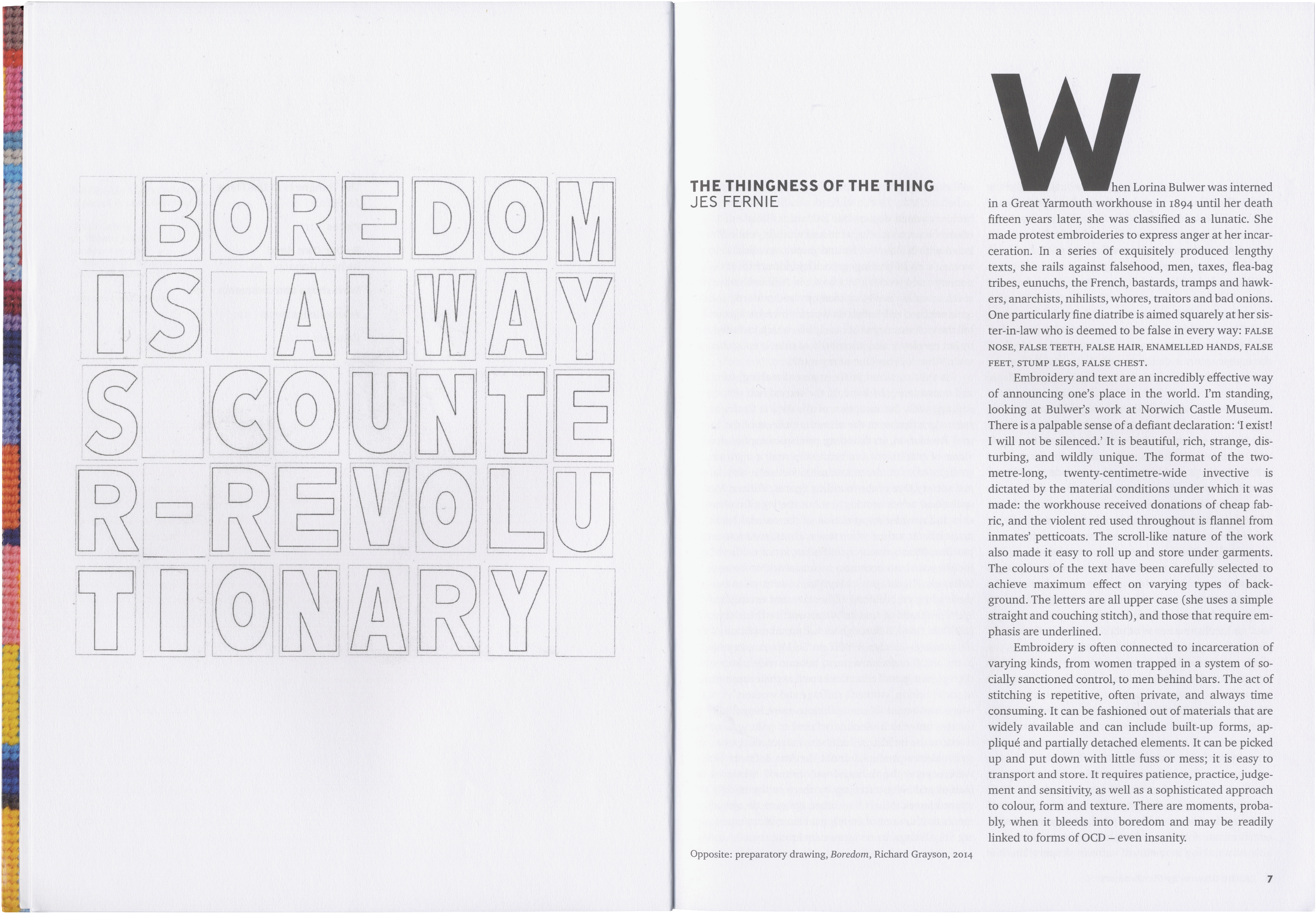
When I meet Richard Grayson, the artist behind the By Our Own Hand project, he tells me that as a challenge to himself he made a piece of embroidery over a three-year period based on one of Guy Debord’s declarations: ‘Boredom is always counter-revolutionary’. He wondered if the act of making this tightly constructed cross-stitch panel would lead him to a conclusion about the nature of boredom. With no hint of disappointment, he says: “The process revealed nothing but pleasure”. The repetitive, absorbing, painstaking process of stitching soon becomes a form of meditation in which the maker enters a dialogue with the materials and the passing of time shifts into an amorphous, unquantifiable haze.
It’s a craft with a noble, convoluted history closely aligned with the labour patterns and social mores of the day. In the 21st century, it is carried out by people with time on their hands and no need for financial or practical gain. It could be viewed as a mode of self-actualisation, a way of finding meaning and joy through the process of making. In the 17th and 18th centuries, sewing, stitching and embroidery was primarily an act of labour, carried out by working class women, predominantly in their home or the home of their employers. It was often tedious, physically demanding (eye-sight and posture were often compromised) and one of the few ways women were able to earn a living and a place in the world. By the early 19th century it was increasingly used to inculcate a sense of obedience, submission and piety in young women, with the emphasis placed on the newly constructed ideology of motherhood. Mary Wollstonecraft, the most glorious of feminist philosophers and writers, penned a passionate critique of the destructive effects of this sedentary occupation that rendered women sickly, restless and lonely: ‘This employment contracts their faculties more than any other by confining their thoughts to their persons.’
Somewhat paradoxically perhaps, this suffocating ideology, so closely aligned with gender, was often used as an instrument for resistance. There are fine stories of women using their needle to stab their way into history, communicate forbidden thoughts, register unmentionable acts and log moments of extreme desperation. It is said that one of the incriminating bits of evidence used to behead Mary Queen of Scots was her treasonous embroidery which depicts her half-sister, Elizabeth I, as a mass of barren twisting vine and tendrils, while Mary is laden with bunches of fecund grapes, an allusion to the women’s child-bearing capacities. Elizabeth Parker, a nursery maid working at a house in Ashburnham on the south coast in the 1830s, used tiny and perfectly formed cross-stitched red letters on a plain linen background to tell the violent story of her early life, which included rape by her employer and attempted suicide. It ends abruptly with ‘what will become of my soul?’.
A shift occurred in the status of making, stitching, constructing by hand, in the second half of the 19th century with the inception of the Arts & Crafts Movement. As a repost to the alienating effects of the industrial revolution, its founding principles expounded the value of traditional craftsmanship and a rigorous reconfiguration of the relationship between art, labour and society. One of the founding figures, William Morris, spoke and wrote movingly about the joy of craftsmanship and a wider appreciation of the natural beauty of materials. At a time when it was considered a woman’s pastime, Morris researched the lost art of medieval embroidery with an eccentric enthusiasm that became his hallmark. His daughter May Morris went on to become the leading embroiderer of her day and established the Women’s Guild of Arts. In Wandsworth, the home of By Our Own Hand, a borough with a proud tradition of textile-making, Evelyn and William De Morgan, key figures in the Arts & Crafts Movement, became widely known for their paintings and ceramics as well as their commitment to social reform, women’s suffrage and workers’ rights. It was a movement whose ambitions were beguilingly seductive but which ultimately failed to gain wide-spread traction: the buildings, furniture, fabrics, wallpaper and embroideries produced under the Arts & Crafts banner were beyond the financial and cultural means of the masses and were taken up by the wealthy middle and upper-classes. Much like other utopian design movements that dreamt of creating a better, more equal society, very little of its revolutionary intent remains today.
My mum gives me a book called Threads: The Delicate Life of John Craske by Julia Blackburn. It tells the story of a Norfolk fisherman who spent a large part of his adult life moving in and out of a ‘stuporous state’. To cope with his separation from the sea and his condition (which would probably be diagnosed today as a form of depression brought on by his WWI army service) he made embroideries. Propped up in bed with a wooden frame fashioned from an old deckchair, he used pudding cloths and scraps of wool and thread to create scenes of the sea: fishermen at work, fighting the elements; menacing skies and tumultuous waves. He and his wife managed to eke out a meagre living selling his work to passers-by, most notably to the poet Valentine and her lover the writer Sylvia Townsend Warner, who stayed in a nearby holiday home. It seems that embroidery, scene-making and make-believe saved Craske from himself.
I visit my partner’s father in Sweden who recently had a stroke. His rehabilitation treatment included using a loom to make a rug which is now placed in the entrance to his apartment. I am taken with the realisation that this is the one thing in a large collection of objects built up over eighty-five years that he has made. Apart from the obvious physical and psychological benefits of this type of activity for stroke victims, there is also the beguiling reality of the thingness of the thing. Its physical properties bear witness to a person’s life, traces the characteristics of that life, and somehow makes manifest a particular moment in that life. It will also, in all likelihood, be used long after my father-in-law is dead, taking on a new guise in another home, creating a link with the past and providing a space for familial hospitality underfoot.
I ask my 16-year-old to send a thank you letter to a relative. She writes the address in the wrong place and applies stamp to envelope like it’s some weird alchemic practice reserved for freaks and witches (“Top right, right?”). The act of writing, using a pen or needle, sending letters, communicating through the physical word, is fast becoming a quaint pastime, a throw-back to a by-gone age. We increasingly inhabit a world made up of code, virtual space and intangible strangeness. It’s exciting to think where this might lead, but it may be a while before we learn how to build a picture of a life that has meaning for future generations to unearth. There’s a Black Mirror episode that has stayed with me since I saw it over two years ago. A young woman is unable to cope with the death of her husband. She is offered the chance to reconnect with him through text messages, using an algorithm based on his online activity, accumulated over his lifetime. When she has wrung this service dry, she progresses to the next level of make-believe and orders an android that looks and acts entirely like her ‘real’ husband, the only difference being that he doesn’t sleep. He lies on his back with his eyes wide open every night, staring up at the ceiling - a glitch in the process of building a character that will no doubt be ironed out as we progress further into the parallel worlds of our desires.
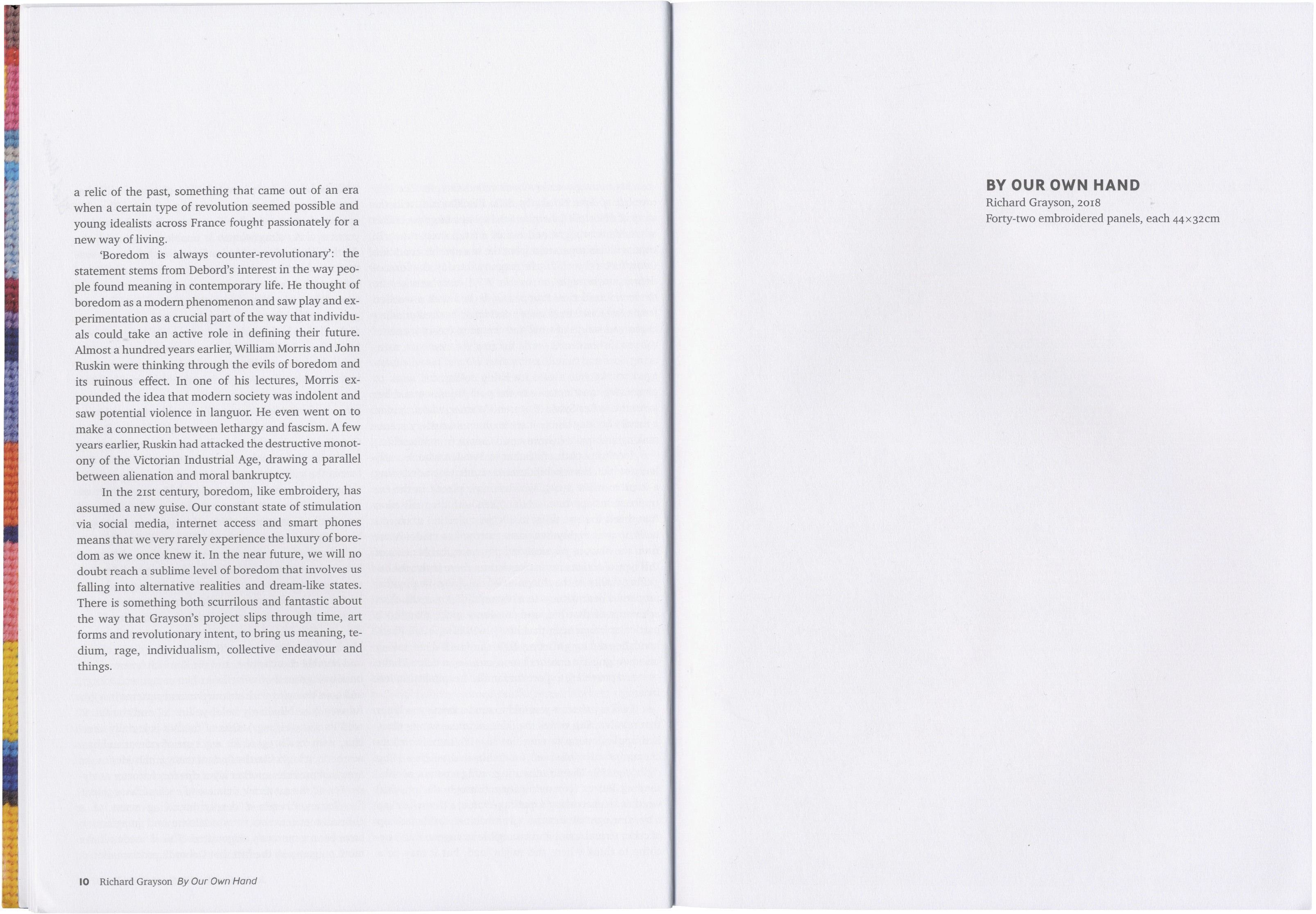
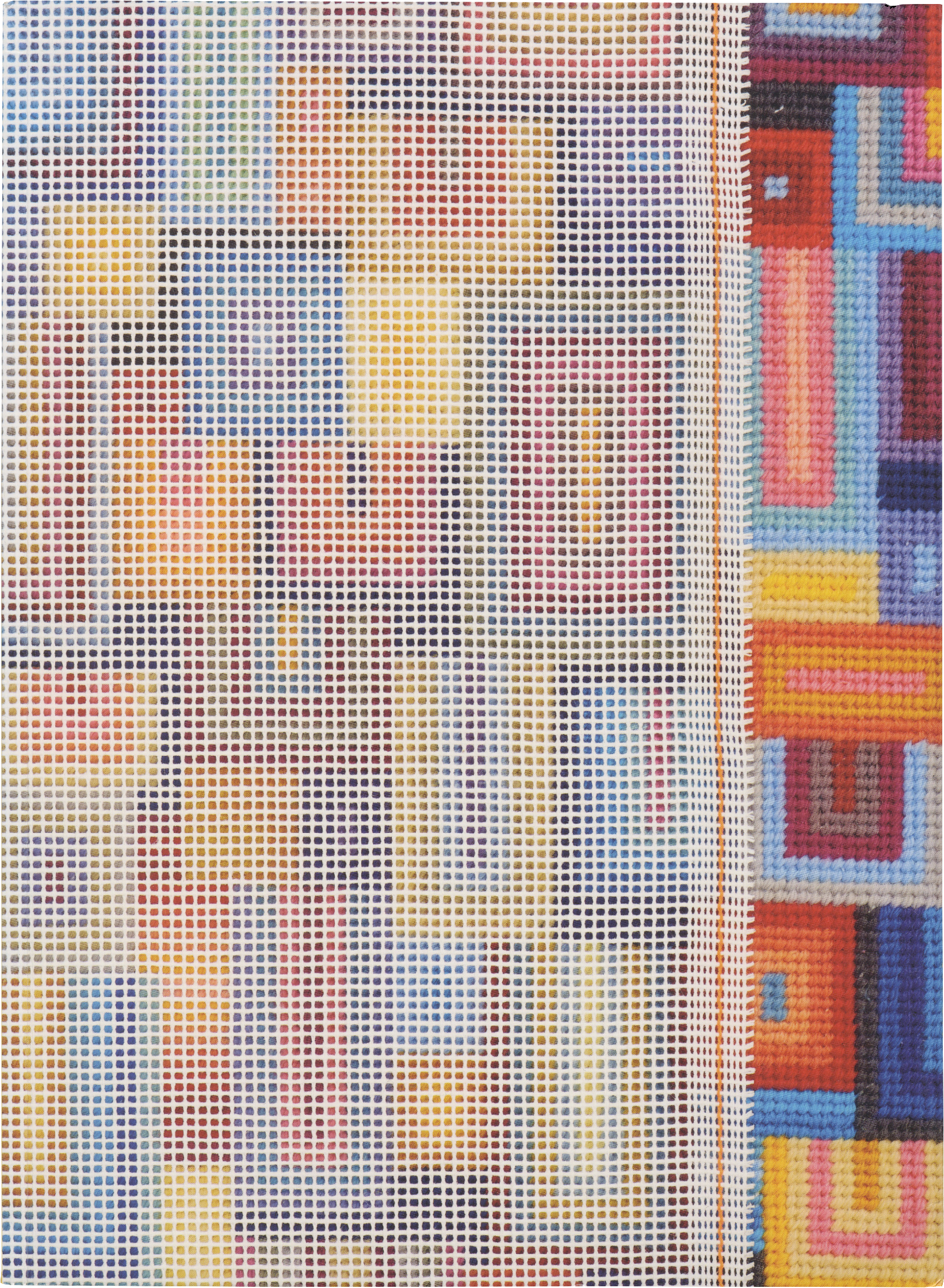
Looking at the embroideries made for the By Our Own Hand project, I become acutely aware of the sculptural nature of stitching. Thread isn’t applied to the surface in the same way as paint; it is an integral part of the thing itself – a unit of construction that exists in three dimensions. This seems important both symbolically and practically. It can’t be erased and can only be destroyed by a laborious process of unpicking or, if the situation calls for more extreme measures, burning, cutting or burying. Each letter has forged a dynamic and dependent relationship to its foundation. Like my father-in-law’s rug, the character of each of those letters carry a permanent imprint of an individual personality. There are ones that include a figurative element (that fabulous blocky, 3-dimensional ‘R’ with its Van Gogh clouds and humble church spire, and the ‘L’ which houses skulls on a background of what looks like computer coding); and ones that play with abstraction and patterns in a joyful way (the blindingly bold, yellow ‘S’ and the fat ‘R’ with its shiny zigzags). One of the ‘N’s is fantastically anarchic; with its disregard for any type of rule or uniform aesthetic; it looks like the back of many embroideries, an area that provides another layer ripe for character analysis. For all the maverick richness of each of these thirty-five letters, there’s a deeply humbling sense of a collective endeavour, to which time and imagination have been generously committed. This is made all the more poignant by the fact that Debord’s proclamation is a relic of the past, something that came out of an era when a certain type of revolution seemed possible and young idealists across France fought passionately for a new way of living.
The statement ‘Boredom is always counter-revolutionary’ stems from Debord’s interest in the way people found meaning in contemporary life. He thought of boredom as a modern phenomenon and saw play and experimentation as a crucial part of the way that individuals could take an active role in defining their future. Almost a hundred years earlier, William Morris and John Ruskin were thinking through the evils of boredom and its ruinous effect. In one of his lectures Morris expounded the idea that modern society was indolent and saw potential violence in languor. He even went on to make a connection between lethargy and fascism. A few years earlier, Ruskin had attacked the destructive monotony of the Victorian industrial age, drawing a parallel between alienation and moral bankruptcy.
In the 21st century, boredom, like embroidery, has assumed a new guise. Our constant state of stimulation via social media, internet access and smart ‘phones means that we very rarely experience the luxury of boredom as we once knew it. In the near future, we will no doubt reach a sublime level of boredom that involves us falling into alternative realities and dream-like states. There is something both scurrilous and fantastic about the way that Grayson’s project slips through time, art forms and revolutionary intent, to bring us meaning, tedium, rage, individualism, collective endeavour and things.