Ghosts and Sculpture
I loved writing this catalogue text for Phantom Sculpture, an exhibition at Mead Gallery in 2023 - 24. It’s about ghostly travel across generations of artists and how ghosts take up three-dimenstional space in our dreams.
Published by University of Warwick, 2024. graphic design by Matthew Stuart & Andrew Walsh-Lister.
We are all haunted by the ghosts of our past, by the hoped-for things that never transpired, by the future that never arrived, by things we said that should have remained unsaid; things we didn’t say; friends, family, dreams and moments we have lost. If we are lucky, we are also visited by more generous, generative ghosts who ply us with enthusiasm and establish a hot-line to the past, creating possibilities for invention and hopeful futures. These ghosts, they shift around us as we move through the world. Sometimes we bump up against them and are startled by their insistence, their clarity, but mostly they are silent, acquiescent, living out their own lives in relative obscurity.
They teach us things, these ghosts. Perhaps it’s the same for artists as they navigate the histories of their discipline, sifting through the achievements, projects and failures of those who lived before them, accruing a pile of immaterial bodies and practices that move them, influence them, irritate them, shunt into their work in some way.
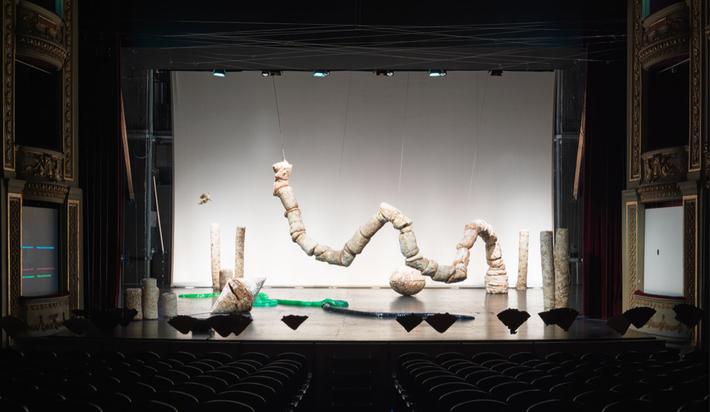
For Phantom Sculpture, works of art made over the past sixty years are presented alongside each other - the march of linear time, art historical movements, and accreted, developmental maps are compressed, tantalisingly live, as notes are passed from one generation to the next, whispers gathering across the gallery space. The artists all forge a connection to the British Isles, in that they were either born here, have spent time here, fled from here, or have lived their entire lives here. So, this is a story about the recent history of British sculpture, in all its parochial glory, bombast, dreaming and fragility.
The story contains many other stories, of course, but the dominance of the dominant story is notable for its insistence. The points at which the baton is handed over, dropped, smashed or cherished by artists of different generations, are clearly identifiable as we move, like an Art History undergraduate syllabus, through the decades. From 1950s abstraction, commitment to natural materials and a kind of post-war delirium (Hepworth), to the 1960s when the ‘New Generation’ banished the plinth in order to forge a more democratic relation to the viewer, and employed industrial and synthetic materials to make minimal, conceptual sculptures that resisted monumentality and embraced dematerialisation (Caro). By the 1980s, ‘New British Sculpture’ (always the new) fulfilled the role of recalcitrant child by rejecting their forebearers to produce elemental, sensual or metaphoric imagery, sometimes using traditional processes and materials (Turnbull). Working under the shadow of the Thatcher years, when the burgeoning free-market economy was establishing the tentacled, malign roots of neo-liberalism, these artists often used the debris of contemporary life to play with colour, humour, and variegated forms of physicality.
The 2000’s brought a less easily packaged range of approaches (the nearer we get to the present, the harder it is to identify the characteristics of an era – it takes time to paint out other voices). There’s the introduction of surrealist language, an exploration of the uncanny (Hatoum and Ekks), and an ongoing experimentation with materials and abstraction (Deacon). Bawdy, rule-breaking louchness was celebrated, and the ready-made was employed to celebrate irreverence and humour (Lucas). It was the dawn of a new millennium, we were drunk on the promise of a Labour government and the delusional idea that capitalist growth would deliver a slipstream of comfort for each successive generation. The Iraq War was the beginning of the end of the dream and by the 2010s we were reaching what Mark Fisher (via Franco Berardi) called ‘the slow cancellation of the future’ in which our ability to differentiate the past from the present was compromised by the impact of postmodernity. This ‘temporal bleed’ or ‘dyschromia’ created a strange simultaneity which, Fisher contends, made it hard to locate oneself in a creative present (there is no ‘now’).
And the 2020s? Where have we arrived? Well, every era seems to revel in the construction of its own cataclysmic end-time scenarios, but this decade is promising to deliver a quite spectacular range of possibilities including onanistic globalisation, muscular authoritarianism, aggressive exploitation of labour across and within countries, increasingly desperate refugee flows, social media-propelled right-wing nationalisms, the ongoing delusion of white supremacy, and the obscene, forever expanding chasm dividing the rich from the poor. As I write, the impact of Britain’s rapacious colonial past is rising to meet the present in the horrors that are unfolding in Palestine, Afghanistan, and the Sudan. And, the most cataclysmic cataclysm of them all, the unravelling climate catastrophe. It seems that Fisher underestimated the future of stunted or unrealised futures.
Throughout all of this, art is still made, things need to be said. The artists in Phantom Sculpture deliver a compelling array of disturbing, beautiful, poetic, angry responses to their place in the world. There is a glorious opening up of the range of voices that we are able to hear, reaching beyond the white, predominantly male makeup of recent art historical movements, to welcome the female, the Black, the disabled, the trans, the working class, the Other. Signalling a resounding refusal of old categories and assumptions around what can and can’t be said, there is a synthesis of figuration and abstraction, and a curiosity about the breakdown of binaries between the non-human and human, male and female, machine and organism.
The bombast of previous generations has gone. It has been replaced by fragility, ambiguity and tenderness (Freije, Ackroyd, Buckley, White, and Darling) along with an understanding of impermanence and our entanglement with nature and each other (Lai). There are shape-shifters and mystics in the fray (Baldock and Ekks), as well as unruly bodies that revel in sex and seduction (Ackroyd). Craft, the touch of the hand, the insistence of the power of making, is beautifully evident (Bax, Collings-James, Baldock, and Ryan), as is a scratching at the perversions of consumerism (Wermers). A refusal of Euro-centric modes of knowledge-building and history-making, and a move to create counter-histories, speculative models and forms of resistance are defiantly present (Collings-James, Buckley, Wahid, and White). And there’s an interest in words, language, different ways of making stories through experimental text and collaboration with writers (Bax, Darling, Buckley, Freije). All these approaches and projects, I think, make it easier for artists – and the artworks themselves – to socialise with, and learn from, ghosts. There is an openness, a vulnerability, a seepage into other worlds that conveys a tangible sense that there are many answers to the same question, and that multiple constellations are possible.
But this tidy, art historical narrative, that moves from the 1960s to the present day, obeys the diktats of linear time, and therefore appears to refuse temporal transgressions of ghostly travel across clearly delimited periods - and causal sequences. Maverick art historian Aby Warburg proposed, through his concept of Nachleben, that this disorienting mash-up of eras where images, in their anachronistic, enigmatic, metaphorical state, produce an afterlife that spans and moves through centuries and multiple art historical timeframes, leads to the ‘paradox where the oldest things may appear as less old ones’. Ghosts need to be able to move through time, to party with older, maybe no wiser ghosts, or ones who are new to the scene, just learning the ropes. It seems clear that dreams, lives, and artistic endeavours are not linear, they are fragmented, they fly across situations, centuries and generations. There is a crackle or glitch where time is out of joint, sounds gather and never die, and a cacophonous present is made manifest. I’m thinking that Phantom Sculpture provides a framework within which to witness this crackle, and I have fabricated a scene in my mind in which the holes in Jonathan Baldock’s and Barbara Hepworth’s sculptures move together in the darkness of the Mead Gallery at night, exchanging stories about material reality, spaces that are infused with hope, and the risks that come with being constrained within the assumed boundaries of one’s existence. Further back, in the darkest corner, the sadness that is present in the work of Dominique White, Kira Freije and William Turnbull find a place to rest within the ghostly ruins of humanity’s future.
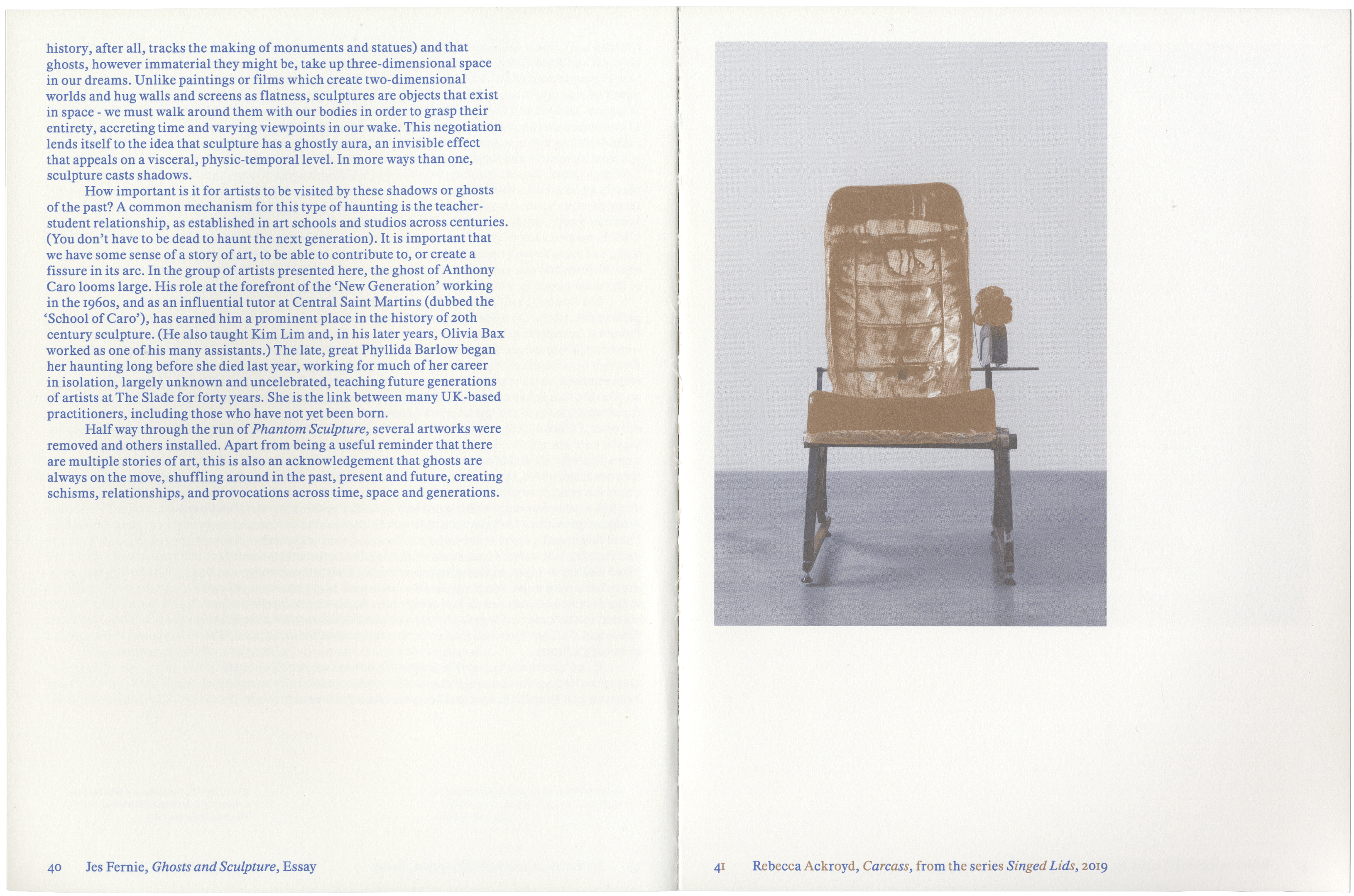
It can’t seem too fanciful to propose that there are probably more ghosts coalescing around sculpture than any other artform. This may have something to do with the fact that sculpture dances close to the body (its history, after all, tracks the making of monuments and statues) and that ghosts, however immaterial they might be, take up three-dimensional space in our dreams. Unlike paintings or films which create two-dimensional worlds and hug walls and screens as flatness, sculptures are objects that exist in space - we must walk around them with our bodies in order to grasp their entirety, accreting time and varying viewpoints in our wake. This negotiation lends itself to the idea that sculpture has a ghostly aura, an invisible effect that appeals on a visceral, physico-temporal level. In more ways than one, sculpture casts shadows.
How important is it for artists to be visited by these shadows or ghosts of the past? A common mechanism for this type of haunting is the teacher-student relationship, as established in art schools and studios across centuries. (You don’t have to be dead to haunt the next generation). It is important that we have some sense of a story of art, to be able to contribute to, or create a fissure, in its arc. In the group of artists presented here, the ghost of Anthony Caro looms large. His role at the forefront of the ‘New Generation’ working in the 1960s, and as an influential tutor at Central Saint Martins (dubbed the ‘School of Caro’), has earned him a prominent place in the history of 20th century sculpture. (He also taught Kim Lim and, in his later years, Olivia Bax worked as one of his many assistants.) The late, great Phyllida Barlow began her haunting long before she died last year, working for much of her career in isolation, largely unknown and uncelebrated, teaching future generations of artists at The Slade for forty years. She is the link between many UK-based practitioners, including those who have not yet been born.
Half way through the run of Phantom Sculpture, seven artworks were removed and others installed in their place. Apart from being a useful reminder that there are multiple stories of art, this is also an acknowledgement that ghosts are always on the move, shuffling around in the past, present and future, creating schisms, relationships, and provocations across time, space and generations.