No More Kings
Artists Dunya Kalantery and Rima Patel worked with children at Willow Bank and Harris Garrard Primary schools in Thamesmead, east London, to make a beautiful book and commission for a new library. The project recognised and encouraged the strangeness - and violence - of children’s imagination. They asked me to write a text for the book in which I discuss play, magic, freedom and sadness.
I’m looking at a series of photographs of children playing in ‘junk parks’ in Denmark, Japan, the UK from the 1950s to the present day. These parks are alternative playgrounds that grew out of the devastation of post-war landscapes to provide places for children to experiment, take risks, and go wild. They are joyful, terrifying and maniacal worlds involving burnt out tyres, hammers, saws, clapped-out old cars, mattresses, bits of wood, and lots of fire. Landscapes are strewn with half-built dens, makeshift aerial runways, tunnels, fire pits, shonky see-saws, and mud caves. It’s every parent’s nightmare and every child’s dream.
I find some films online – archival black and white footage, alongside more recent colour film – and for a fleeting moment I am removed from the formal shackles of my work desk and thrown into a world of anarchy. Children all around are jumping, clambering, swinging, digging, swearing, yelling, setting things alight. Others are sitting quietly, dreaming, painting, singing. They are steeped in mud, glee, and determination. I can’t help smiling at the hopefulness of it all. I get a lump in my throat when I see a young girl swing wildly across a stream on a precarious-looking bit of old rope that is tied to a huge tree. Her face moves from serious focus to stark fear, and ultimately elation when she manages to reach the other side. It’s the kind of experience that is not only joyful in the moment but prepares children for the turmoil of life beyond childhood. It is also an experience that children are increasingly alienated from, in a society that militates against risk, injury, challenge, and fear.
These kids would no doubt fare well on the Island of Thamesmead in 2090, from which all adults have gone, leaving children to roam free. In this east London community, children construct their own world, join forces with seagulls to collect plastic bags and lonely shoes, forge friendships with colours, burn bad energy, and when they fail, they build again. Pretty soon, they find out they need to know where they have come from in order to have a sense of where they are going. They discover the importance of stories, and of things they’ve amassed. They understand that they need to slow down and take time to listen in order to hear what things are saying. If only adults were so wise: these activities could save us from ourselves, and earth from us, marking out a path to an alternate future in which defiance and freedom form joyous pitstops along the way.
MAGIC
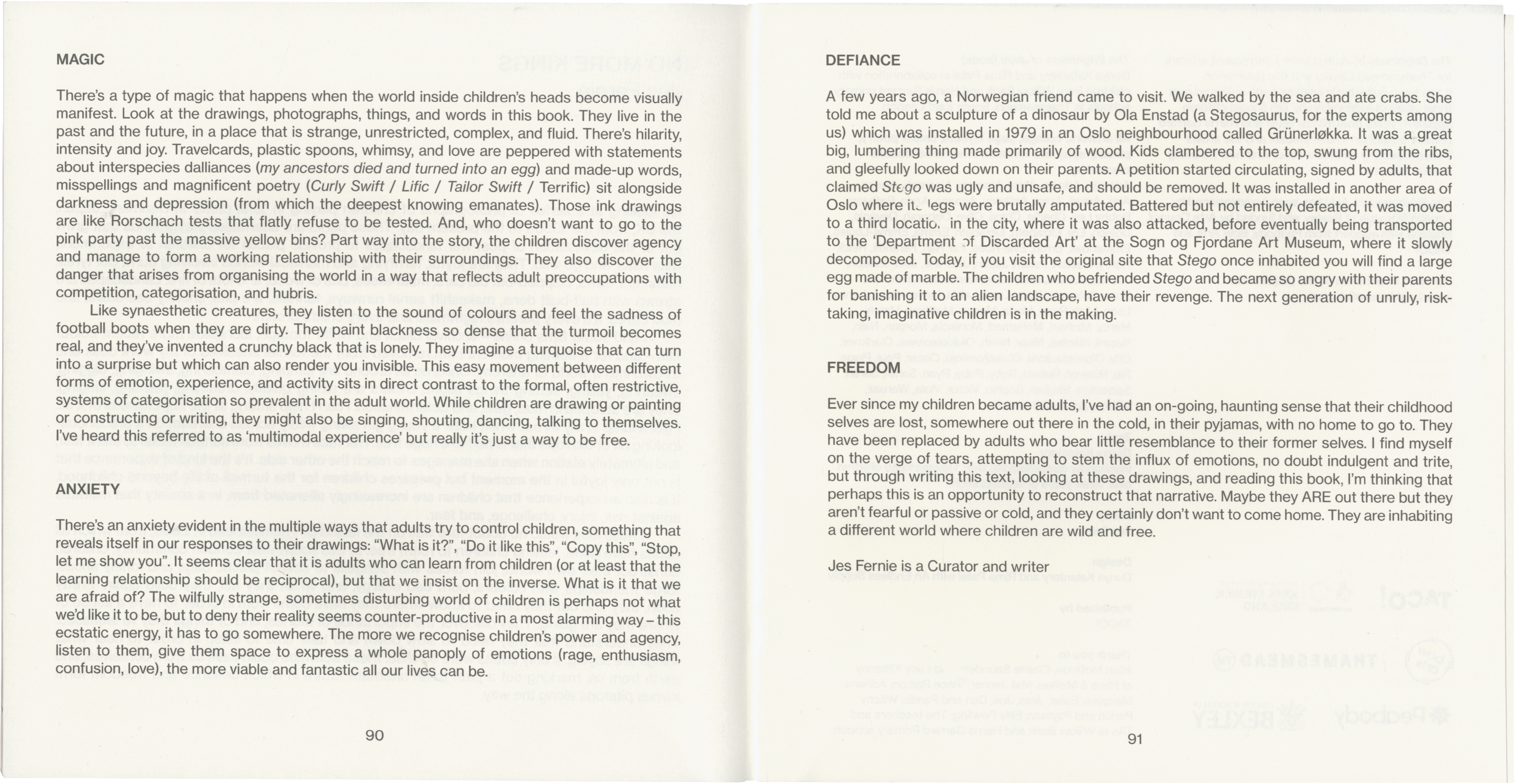
There’s a type of magic that happens when the world inside children’s heads become visually manifest. Look at the drawings, photographs, things, and words in this book. They live in the past and the future, in a place that is strange, unrestricted, complex, and fluid. There’s hilarity, intensity and joy. Travelcards, plastic spoons, whimsy, and love are peppered with statements about interspecies dalliances (my ancestors died and turned into an egg) and made-up words, misspellings and magnificent poetry (Curly Swift / Lific / Tailor Swift / Terrific) sit alongside darkness and depression (from which the deepest knowing emanates). Those ink drawings are like Rorschach tests that flatly refuse to be tested. And, who doesn’t want to go to the pink party past the massive yellow bins? Part way into the story, the children discover agency and manage to form a working relationship with their surroundings. They also discover the danger that arises from organising the world in a way that reflects adult preoccupations with competition, categorisation, and hubris.
Like synaesthetic creatures, they listen to the sound of colours and feel the sadness of football boots when they are dirty. They paint blackness so dense that the turmoil becomes real, and they’ve invented a crunchy black that is lonely. They imagine a turquoise that can turn into a surprise but which can also render you invisible. This easy movement between different forms of emotion, experience, and activity sits in direct contrast to the formal, often restrictive, systems of categorisation so prevalent in the adult world. While children are drawing or painting or constructing or writing, they might also be singing, shouting, dancing, talking to themselves. I’ve heard this referred to as ‘multimodal experience’ but really it’s just a way to be free.
ANXIETY
There’s an anxiety evident in the multiple ways that adults try to control children, something that reveals itself in our responses to their drawings: “What is it?”, “Do it like this”, “Copy this”, “Stop, let me show you”. It seems clear that it is adults who can learn from children (or at least that the learning relationship should be reciprocal), but that we insist on the inverse. What is it that we are afraid of? The wilfully strange, sometimes disturbing world of children is perhaps not what we’d like it to be, but to deny their reality seems counter-productive in a most alarming way – this ecstatic energy, it has to go somewhere. The more we recognise children’s power and agency, listen to them, give them space to express a whole panoply of emotions (rage, enthusiasm, confusion, love), the more viable and fantastic all our lives can be.
DEFIANCE
A few years ago, a Norwegian friend came to visit. We walked by the sea and ate crabs. She told me about a sculpture of a dinosaur by Ola Enstad (a Stegosaurus, for the experts among us) which was installed in 1979 in an Oslo neighbourhood called Grünerløkka. It was a great big, lumbering thing made primarily of wood. Kids clambered to the top, swung from the ribs, and gleefully looked down on their parents. A petition started circulating, signed by adults, that claimed Stego was ugly and unsafe, and should be removed. It was installed in another area of Oslo where its legs were brutally amputated. Battered but not entirely defeated, it was moved to a third location in the city, where it was also attacked, before eventually being transported to the ‘Department of Discarded Art’ at the Fjordane Art Museum, where it slowly decomposed. Today, if you visit the original site that Stego once inhabited you will find a large egg made of marble. The children who befriended Stego and became so angry with their parents for banishing it to an alien landscape, have their revenge. The next generation of unruly, risk-taking, imaginative children is in the making.
FREEDOM
Ever since my children became adults, I’ve had an on-going, haunting sense that their childhood selves are lost, somewhere out there in the cold, in their pyjamas, with no home to go to. They have been replaced by adults who bear little resemblance to their former selves. I find myself on the verge of tears, attempting to stem the influx of emotions, no doubt indulgent and trite, but through writing this text, looking at these drawings, and reading this book, I’m thinking that perhaps this is an opportunity to reconstruct that narrative. Maybe they ARE out there but they aren’t fearful or passive or cold, and they certainly don’t want to come home. They are inhabiting a different world where children are wild and free.