The Egg Turns into the Duck!
I was invited by Harriet Loffler, Director of The Women’s Art Collection at Murray Edwards College, to interview artist Katie Schwab on her new body of work for Relative Ties, an exhibition of artworks by women in the Nicholson family. The conversation below was included in the catalogue, published by The Women’s Art Collection and Paul Holberton Publishing in 2026. We discuss family histories, continual growth, sadness and repair.
JF: Throughout the process of researching, making and installing this series of works, you have been living with many ghosts, including the ghosts of EQ, Nancy, your grandmother, your mother, and perhaps the ghost of your future self. How did you find this process of convening a séance?
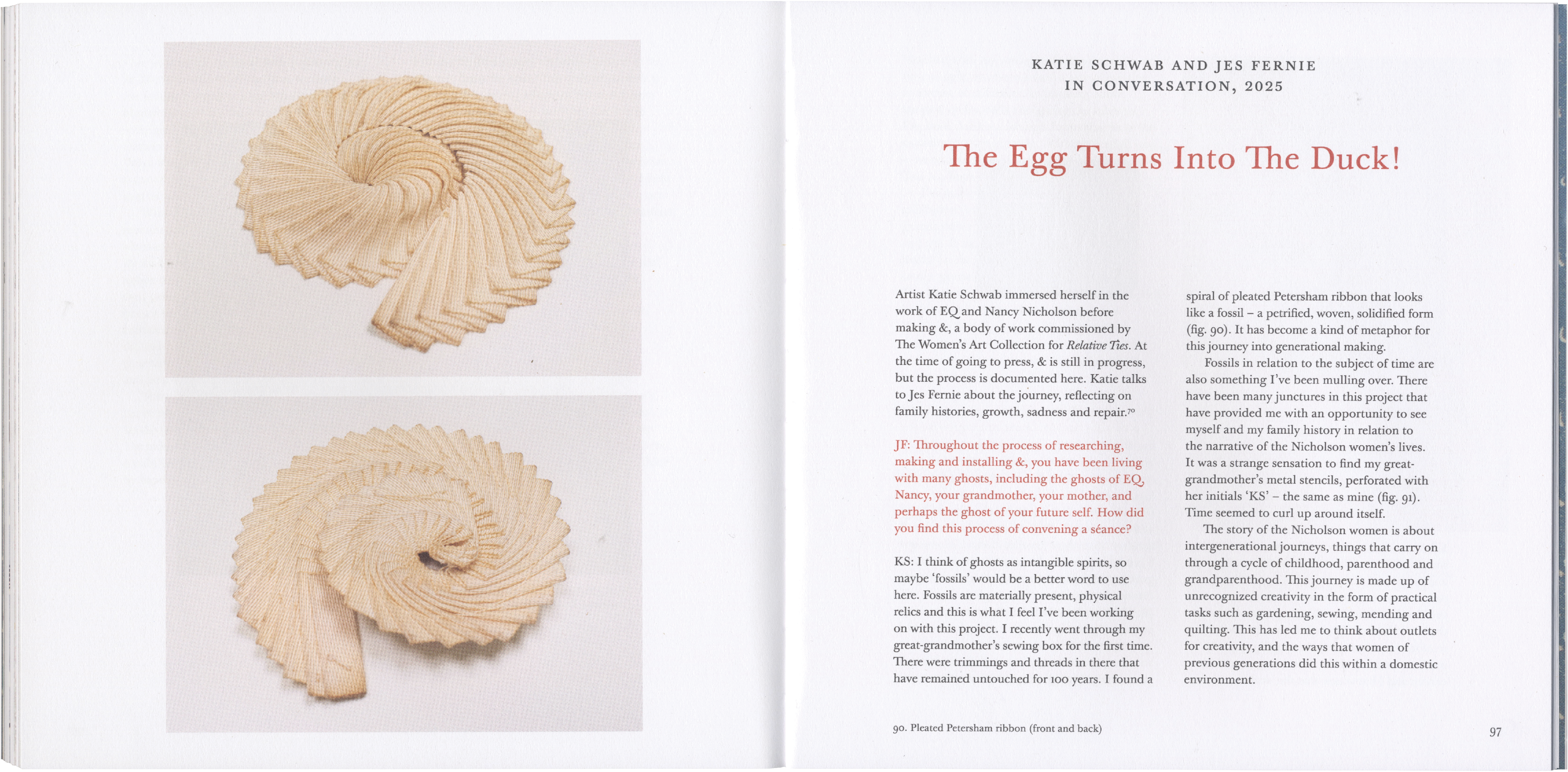
KS: I think of ghosts as intangible spirits, so maybe ‘fossils’ would be a better word to use here. Fossils are materially present, physical relics and this is what I feel I’ve been working on with this project. I recently went through my great grandmother’s sewing box for the first time. There were trimmings and threads in there that have remained untouched for a hundred years. I found a spiral of pleated grosgrain ribbon that looks like a fossil – a petrified, woven, solidified form. It has become a kind of metaphor for this deep divejourney into generational making.
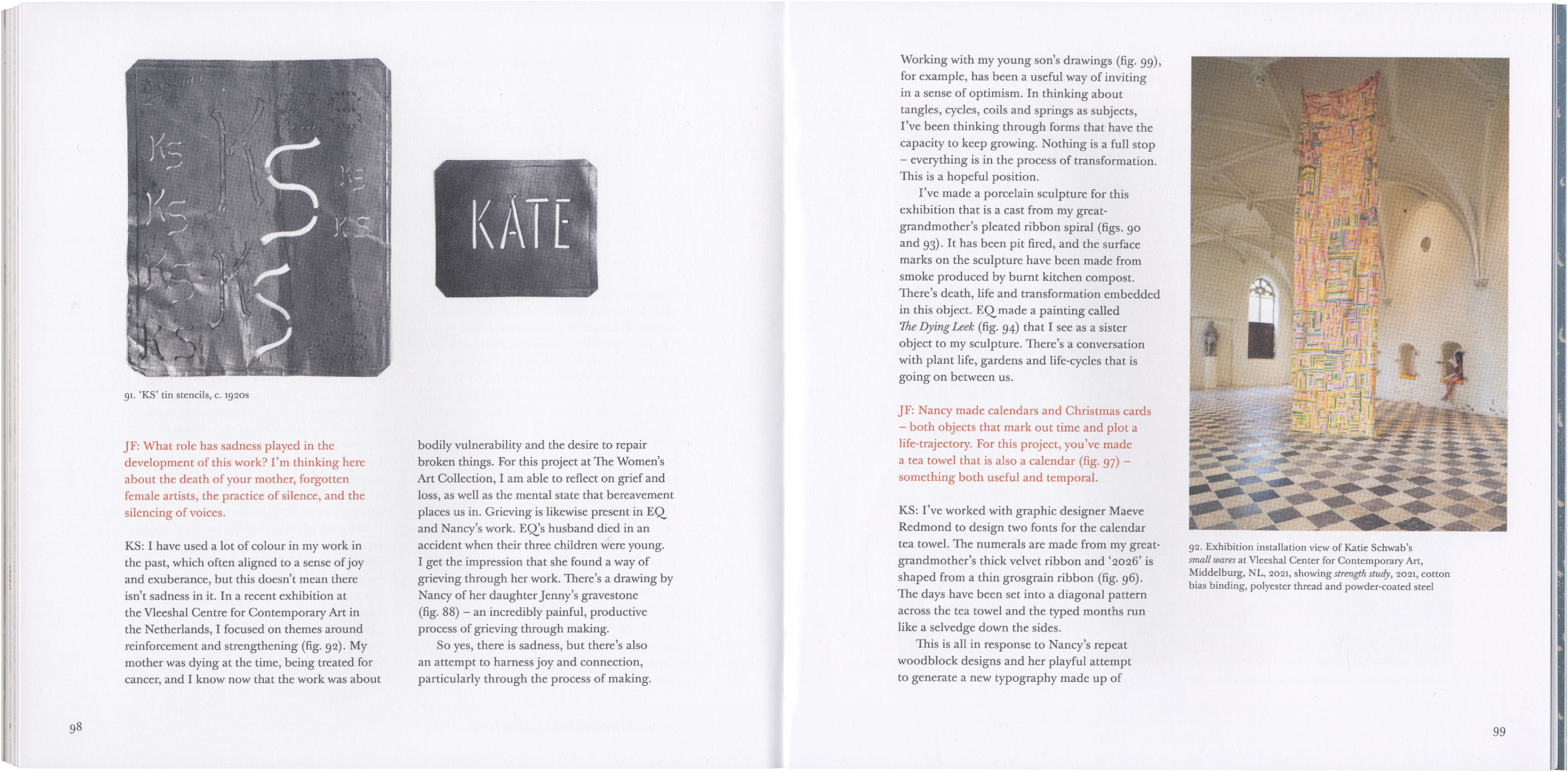
Fossils in relation to the subject of time is also something I’ve been mulling over. There have been many junctures in this project that have provided me with an opportunity to see myself and my family history in relation to the narrative of the Nicholson women’s lives. It was a strange sensation to find my great grandmother’s metal stencils, perforated with her initials ‘KS’ - the same as mine. Time seemed to curl up around itself. The story of the Nicholson women is a story about intergenerational journeys, things that carry on through a cycle of childhood, parenthood and grandparenthood. This journey is made up of unrecognised creativity in the form of practical tasks such as gardening, sewing, mending and quilting. This has led me to think about outlets for creativity, and the ways that women of previous generations did this within a domestic environment.
JF: What role has sadness played in the development of this work? I’m thinking here about the death of your mother, forgotten female artists, the practice of silence, and the silencing of voices.
KS: I have used a lot of colour in my work in the past, which often aligned to a sense of joy and exuberance, but this doesn’t mean there isn’t sadness in it. In an exhibition I did at the Vleeshal Centre for Contemporary Art in the Netherlands recently, I focused on themes around reinforcement and strengthening. My mother was dying at the time, being treated for cancer, and I know now that the work was about bodily vulnerability and the desire to repair broken things. For this project at The Women’s Art Collection I am able to reflect on grief and loss, as well as the mental state that bereavement places us in. Grieving is also present in EQ and Nancy’s work. EQ’s husband died in an accident when their three children were young. In an interview carried out when she was in her eighties, she said “My life has been made up of a sequence of little shocks”. I get the impression that she found a way of grieving through her work. There’s a drawing by Nancy of her daughter Jenny’s gravestone – an incredibly painful, productive process of grieving through making.
So yes, there is sadness, but there’s also an attempt to harness joy and connection, particularly through the process of making. Working with my small son’s drawings, for example, has been a useful way of inviting in a sense of optimism. In thinking about tangles, cycles, coils and springs as subjects – I’ve been thinking through forms that have the capacity to keep growing. Nothing is a full stop – everything is in the process of transformation. This is a hopeful position.
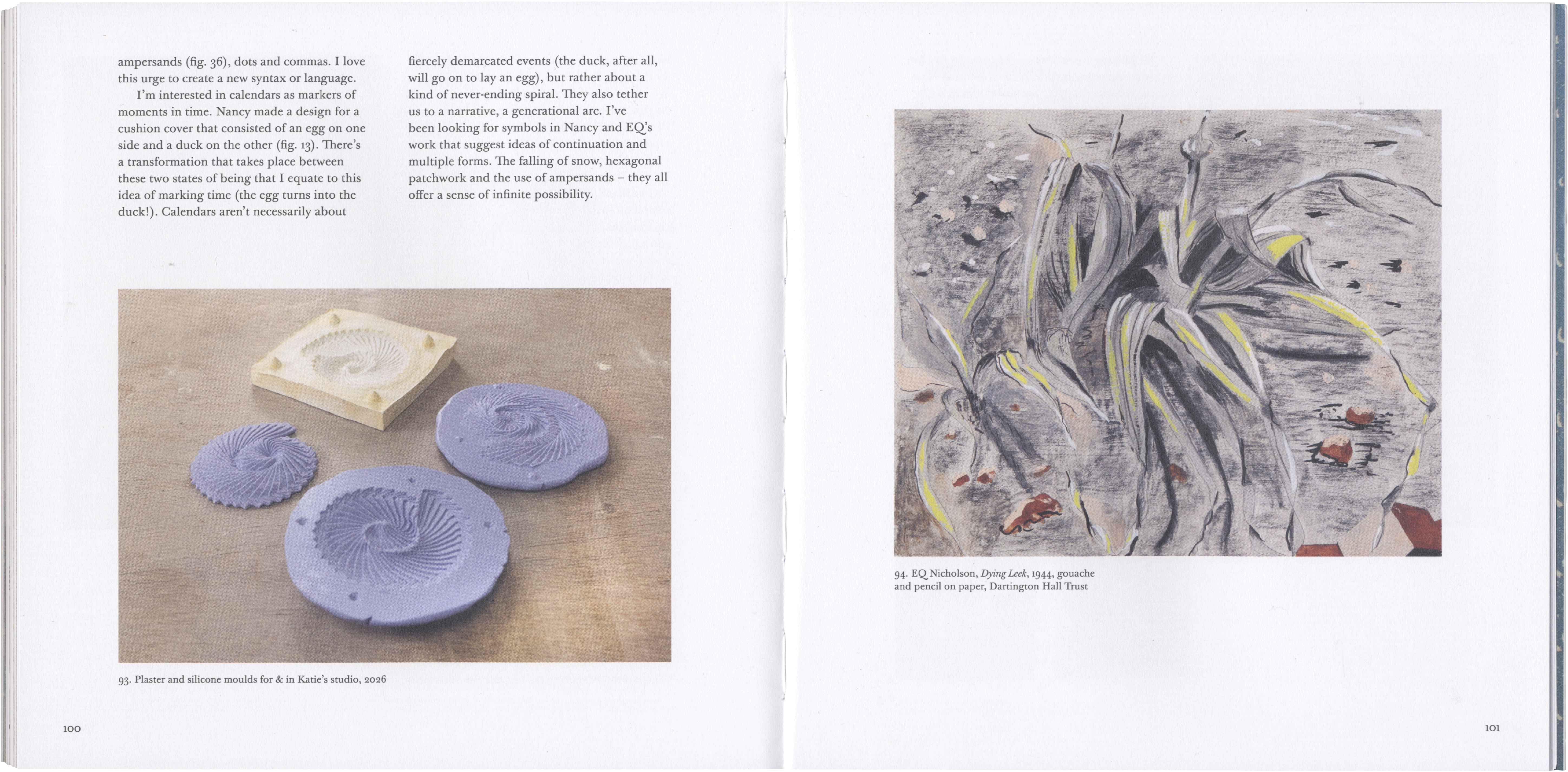
I’ve made a ceramic sculpture for this exhibition which is a cast from my great grandmother’s pleated ribbon spiral. It is glazed with ash made from weeds found in the Murray Edwards College garden. So, there’s death, life and transformation embedded in this object. EQ made a painting called The Dying Leek (1944) that I see as a sister object to my sculpture. There’s a conversation with plant-life, gardens, and life-cycles that is going on between us.
JF: Nancy made calendars and Christmas cards – both objects that mark out time and plot a life-trajectory. For this project, you’ve made a tea-towel that is also a calendar: something both useful and temporal.
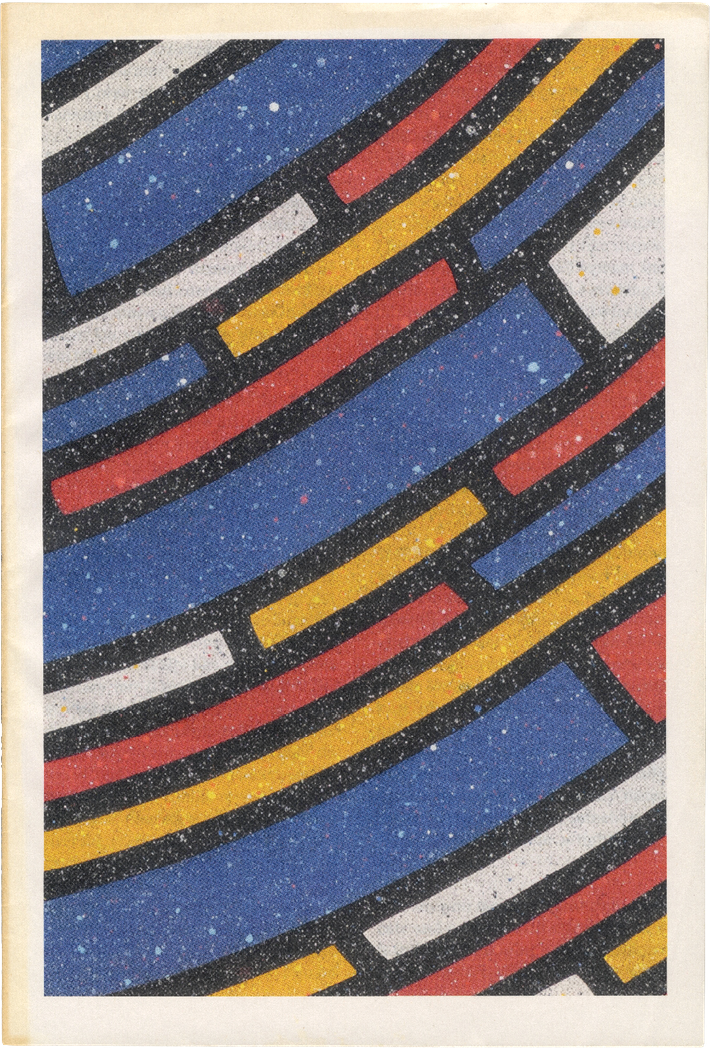
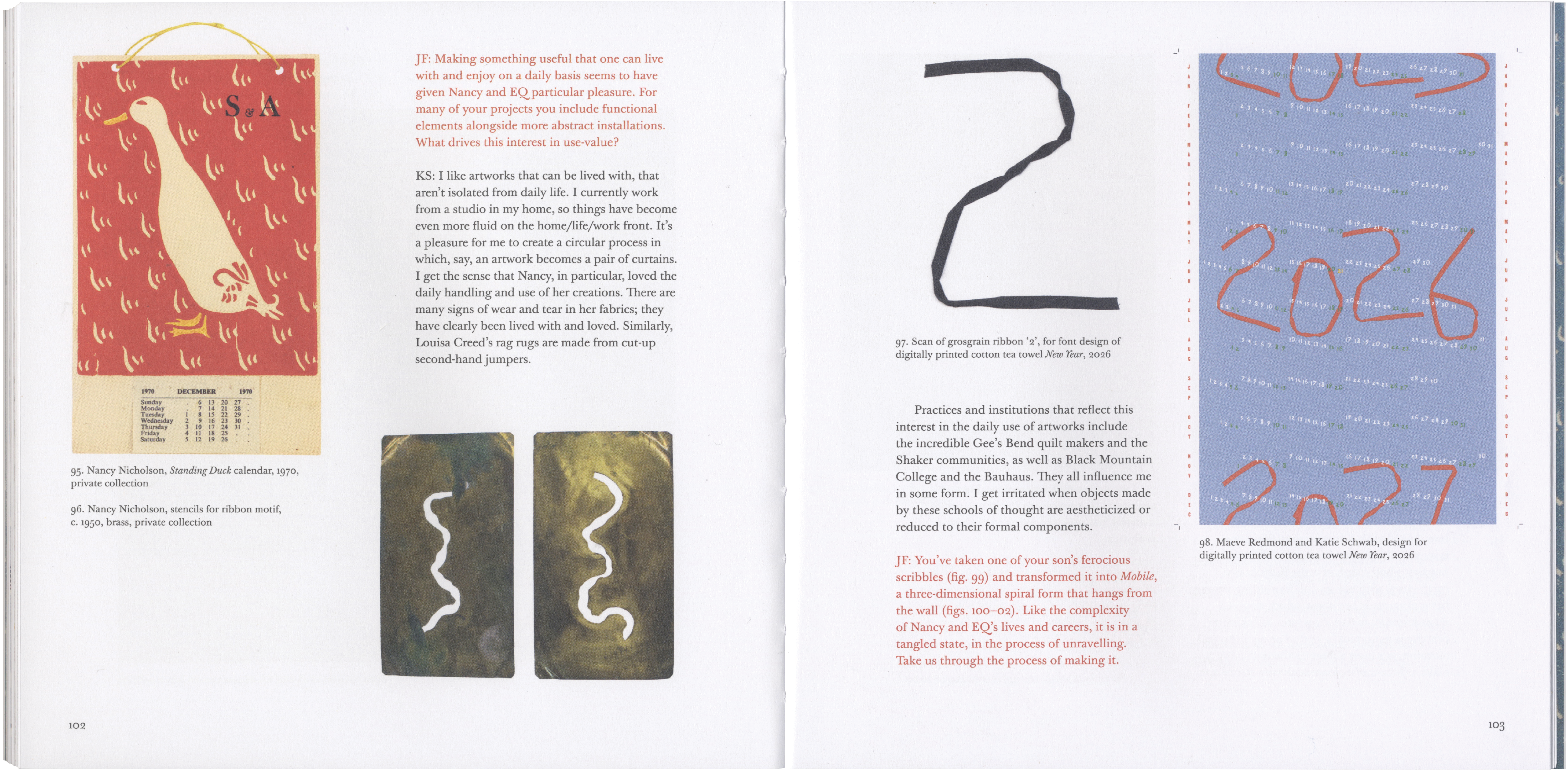
KS: I’ve worked with graphic designer Maeve Redmond to design two fonts for the screen-printed calendar. The numerals are made from my grandmother’s narrow grosgrain ribbon and ‘2026’ is shaped from a thick velvet ribbon. The numbers have been set into a diagonal pattern across the tea towel. The letters for each day and month are hand-carved in lino and these run like a selvedge down the sides of the tea towel. We’ve also created a metal stencil to hand-print our initials onto the back of each work, in a nod to the labels Nancy made for the Poulk Press.
This is all in response to Nancy’s repeat woodblock designs and her playful attempt to generate a new typography made up of ampersands, dots and commas. I love this urge to create a new syntax or language.
I’m interested in calendars as markers of moments in time. Nancy made a design for a cushion cover that consisted of an egg on one side and a duck on the other. There’s a transformation that takes place between these two states of being that I equate to this idea of marking time (the egg turns into the duck!). Calendars aren’t necessarily about fiercely demarcated events (the duck, after all, will go on to lay an egg), but rather about a kind of never-ending spiral. They also tether us to a narrative, a generational arc. I’ve been looking for symbols in Nancy and EQ’s work that suggest ideas of continuation and multiple forms – the falling of snow, hexagonal patchwork and the use of ampersands, they all offer a sense of infinite possibility.
JF: Making something useful that one can live with and enjoy on a daily basis seems to have given Nancy and EQ particular pleasure. For many of your projects you include functional elements alongside more abstract installations. What drives this interest in use-value?
KS: I like artworks that can be lived with; ones that aren’t isolated from daily life. I currently work from a studio in my home, so things have become even more fluid on the home, life, work front. It’s a pleasure for me to create a circular process in which, say, an artwork becomes a pair of curtains. I get the sense that Nancy, in particular, loved this daily handling and use of her creations. There are many signs of wear and tear in her fabrics; they have clearly been lived with and loved. Similarly, Louisa Creed’s rag rugs are made from cut-up second-hand jumpers.
Practices and institutions that reflect this interest in daily use of artworks include the incredible Gee’s Bend quilt makers and the Shaker communities, as well as Black Mountain College and the Bauhaus. They all influence me in some form. I get irritated when objects made by these schools of thought are aestheticized or reduced to their formal components.
JF: You’ve taken one of your son’s ferocious scribbles and transformed it into a three-dimensional, spiral form that hangs from the ceiling. Like the complexity of Nancy and EQ’s lives and careers, it is in a tangled state, in the process of unravelling. Take us through the process of making this work.
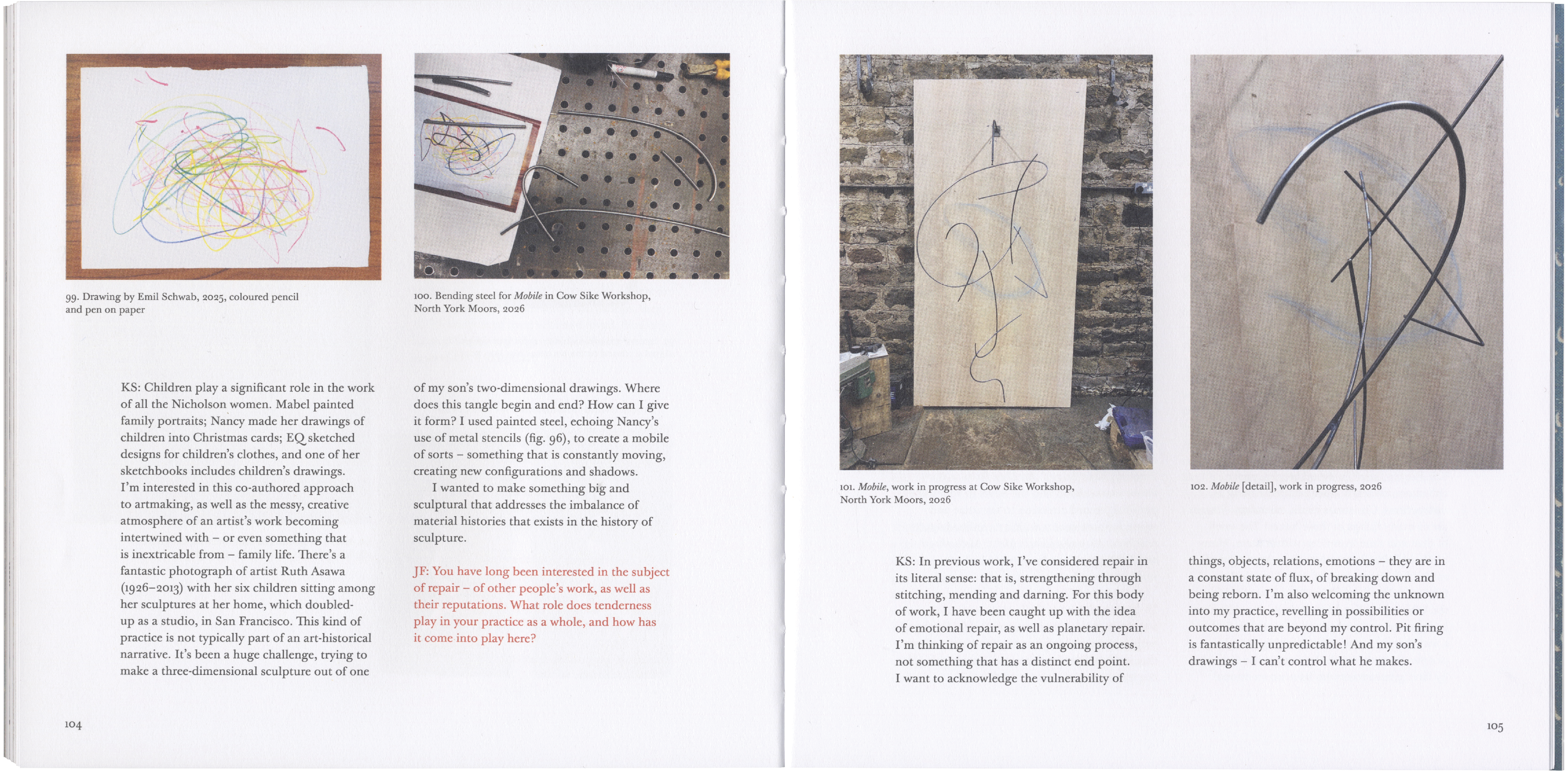
KS: Children play a significant role in the work of all the Nicholson women. Mabel painted family portraits; Nancy made her drawings of children into Christmas cards; EQ sketched designs for children’s wear, and there’s even a sketchbook that includes children’s drawings. I’m interested in this co-authored approach to art-making, as well as the messy, creative atmosphere of an artist’s work becoming intertwined with – or even something that is inextricable from - family life. There’s a fantastic photograph of artist Ruth Asawa (1926 – 2013) with her six children sitting amongst her sculptures at her home, which doubled-up as a studio, in San Francisco. This kind of practice is not typically part of an art historical narrative.
It's been a huge challenge, trying to make a three-dimensional sculpture out of one of my son’s two-dimensional drawings. Where does this tangle begin and end? How can I give it form? I used brass as a material, to echo Nancy’s use of metal stencils, in order to create a mobile of sorts, and to make something that is constantly moving, creating new configurations and shadows.
I wanted to make something big and sculptural that addresses the imbalance of material histories that exists in the history of sculpture. The work has visible welded joins and a ‘living’ finish that welcome patination and oxidation.
JF: You have long been interested in the subject of repair – of other people’s work as well as their reputations. What role does tenderness play in your practice as a whole, and how has it come into play here?
KS: In previous work, I’ve considered repair in its literal sense, that is, strengthening through stitching, mending and darning. For this body of work, I have been caught up with the idea of emotional repair, as well as planetary repair. I’m thinking of repair as an on-going process, not something that has a distinct end point. I want to acknowledge the vulnerability of things, objects, relations, emotions – they are in a constant state of flux, of breaking down and being reborn. I’m also welcoming the unknown into my practice, revelling in possibilities or outcomes that are beyond my control. That ash glaze, it’s fantastically unpredictable! And my son’s drawings – I can’t control what he makes.
JF: You often look for a community to work with – a history, group, language, or technique that roots you to a particular place or atmosphere. How does this tether you to life and to your practice?
LS: You’re right, I usually embed myself in a place, a community or a context, but for this project, I’ve embedded myself within the stories of intergenerational communities of women who lived over the last century. It’s a slightly stranger, perhaps more lonely place to inhabit, but as the work moved from concept to production, I found a community of ceramicists, metal workers and gardeners to collaborate with.
JF: When somebody dies, there are boxes of things, memories and complex relations to sift through and order. These, in turn, are thinned out by the next generation. This weighing up of value seems to be particularly poignant in the case of lives that have been lived in the shadows. What did Nancy leave behind in her boxes and who is looking after them now?
KS: Fabrics, stencils, wood blocks, paper ephemera, sketches, door plates, printing instructions, Christmas cards, calendars – there are so many things in these boxes! The smell of dust and time lives deep within them. Many of Nancy’s family members have kept hold of some of the items, and of course, a selection of fabrics and wallpapers by EQ are now held in The Whitworth , but on the whole, the collection is dispersed and precarious. We need to find a way that they can retain meaning for other people. So many works by women are discarded by later generations who have no emotional or intellectual – or practical! – connection to artworks, and they aren’t assumed to have any value. In the process, we lose a bit of history. Perhaps these things should be used or transformed into something else, rather than collected?
JF: Literature has played an important part in expressing and communicating the inner voices of women and their complex, often stifled lives. What were you reading whilst making these works?
KS: It’s taken me a long time to return to reading after the past two years, but for most of my life, I have read a lot and gained a huge amount from literature and non-fiction. Looking at a list of books I’ve read recently, I realise that they swim into a headspace that sings to the tune of the things I make and the daily reality of my life. There is a lot about motherhood, death and grieving. Joan Didion’s startling, gruesome reflections on the vortex of grief she experienced as a result of the death of her partner, and the illness of her daughter in The Year of Magical Thinking; Kate Briggs’ The Long Form is a story about motherhood and the novel in which she pays heightened attention to minutiae and repetitive movements within a confined space; and Iman Mersal’s How to Mend: Motherhood and Its Ghosts is a faux how-to book about unconditional love, expectations and guilt.
JF: Murray Edwards College is a space for women to think, write, read and critically engage with the world. As the setting for a body of work that looks into female endeavour, how has this rich context impacted on your approach?
KS: I love that The Women’s Art Collection is displayed across the College, in the halls of residence, the dining room, the cafe and corridors. The works are part of daily life.
Anni Albers made beautiful woven, tartan bedspreads for Harvard students in 1949 and ten years later, in 1959, Charlotte Perriand designed an exquisite, modernist study bedroom for Brazilian students at Cité Universitaire in Paris. And Althea McNish designed a ‘Bachelor Girl’s Bedroom’ for the 1966 Ideal Home Exhibition that provided a space for an independent woman to pursue her career, unshackled from societal and familial expectations. There’s something tender and hopeful about making something for the next generation.
JF: The idea of a future rather than a past utopia seems to be embedded in the 20th century architecture of Murray Edwards College. Unlike many of the traditional 15th - 19th century, ornate gothic colleges (originally inhabited by male students), Murray Edwards is a brutalist, forward-looking structure. When the past isn’t a place that can provide you with access and a feeling of safety, I guess the future is the place to strive for.
KS: This exhibition looks out onto the flowing water in Fountain Court, a backdrop that speaks to forces of motion and dynamic change. The porousness of the architecture of the College, with its huge expanse of windows, creates a wonderful connection to the informal garden which has areas devoted to biodiversity and is a haven for wildlife. Unlike any other Cambridge college, students are invited to pick the flowers, herbs and other edibles. There’s a lovely analogy here with the growth of the students’ learning and the growth of the plants, as well as the seasonal changes that are an intrinsic part of the academic year, the garden and the rhythm of student life.
JF: Circular stories, once again! How do you feel about the kind of lives your artworks might live in the years beyond the exhibition? Will they be reinvented, taking on new guises elsewhere, or perhaps they’ll become part of the fabric of student life?
KS: I love the idea that the tea towel calendar has been made for 2026, but I hope it will be used long into the future, in student kitchens or people’s homes. I have one of my grandmother’s calendar tea towels from 1975 that I still use.
The other works will be embarking on their own material journeys- the brass sculpture will change over time, developing a patina. The ribbon spiral, once an adornment for a hat or bag, has transformed into an embossed print, and a ceramic sculpture. As a cast, it has the potential to be reproduced and distributed to different spaces. In all likelihood though, this work will probably end up back in my son’s bedroom. He is fascinated by ammonites!