Hopeful Futures
This piece is a response to Steve McQueen’s Year 3 project, which garnered wide-spread acclaim after its showing at Tate Britain in 2020. It was published by Art Monthly in the January 2020 edition.
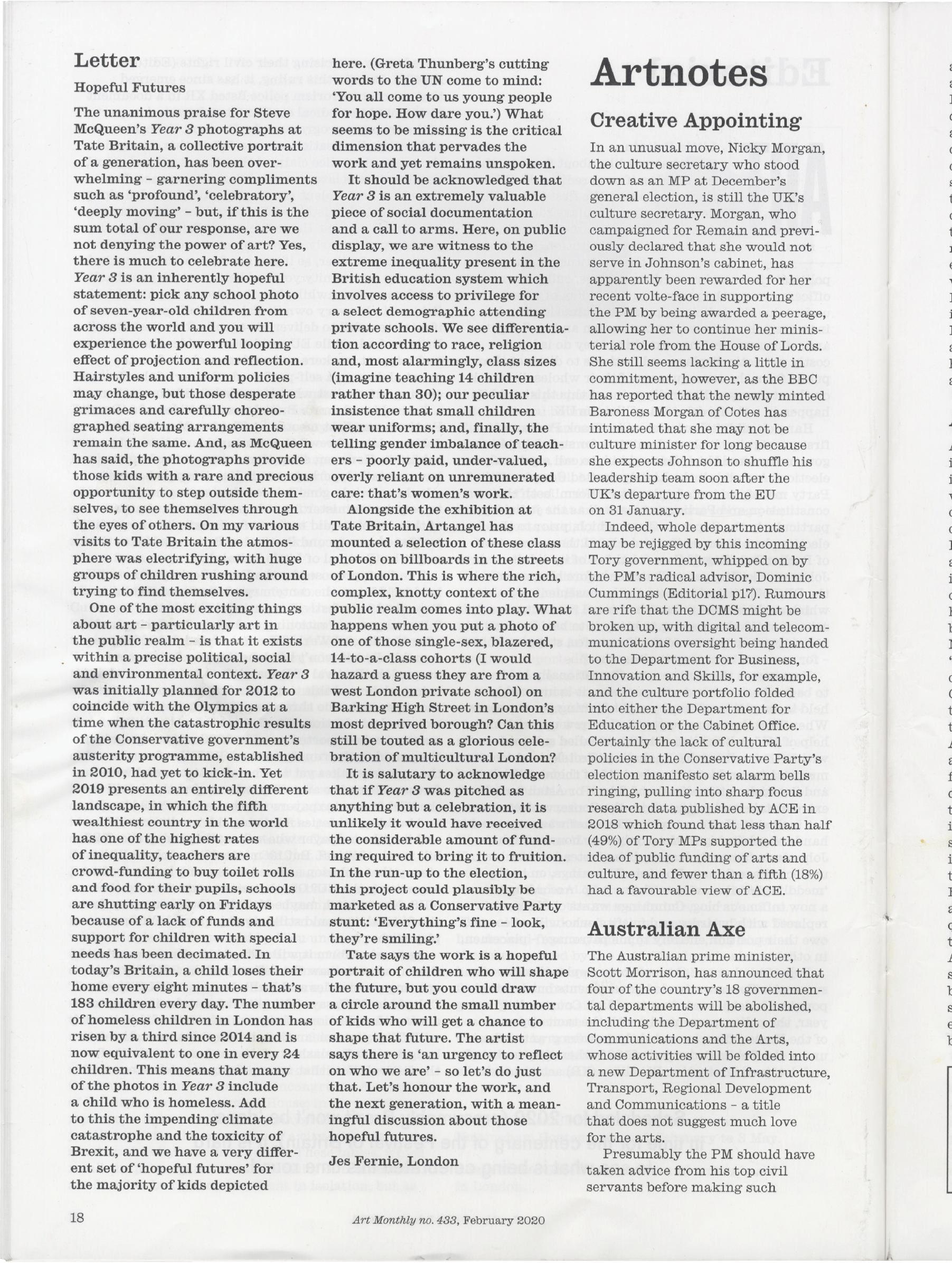
The unanimous praise for Steve McQueen’s Year 3 photographs at Tate Britain, a collective portrait of a generation, has been overwhelming – garnering plundits such as ‘profound’, ‘celebratory’, ‘deeply moving’ – but, if this is the sum total of our response, are we not denying the power of art? Yes, there is much to celebrate here. Year 3 is an inherently hopeful statement: pick any school photo of seven-year-old children from across the world and you will experience the powerful looping effect of projection and reflection. Hairstyles and uniform policies may change, but those desperate grimaces and carefully choreographed seating arrangements remain the same. And, as McQueen has said, the photographs provide those kids with a rare and precious opportunity to step outside themselves, to see themselves through the eyes of others. On my various visits to Tate Britain the atmosphere was electrifying, with huge groups of children rushing around trying to find themselves.
One of the most exciting things about art – particularly art in the public realm – is that it exists within a precise political, social and environmental context. Year 3 was initially planned for 2012 to coincide with the Olympics at a time when the catastrophic results of the Conservative government’s austerity programme, established in 2010, had yet to kick-in. Yet 2019 presents an entirely different landscape, in which the fifth wealthiest country in the world has one of the highest rates of inequality, teachers are crowd-funding to buy toilet rolls and food for their pupils, schools are shutting early on Fridays because of a to lack of funds and support for children with special needs has been decimated. In today’s Britain, a child loses their home every eight minutes – that’s 183 children every day. The number of homeless children in London has risen by a third since 2014 and is now equivalent to one in every 24 children. This means that many of the photos in Year 3 include a child who is homeless. Add to all of this the impending climate catastrophe and the toxicity of Brexit, and we have a very different set of ‘hopeful futures’ for the majority of kids depicted here (Greta Thurnberg’s cutting words to the UN come to mind: ‘You all come to us young people for hope. How dare you’). What seems to be missing is the critical dimension that pervades the work and yet remains unspoken.
It should be acknowledged that Year 3 is an extremely valuable piece of social documentation and a call to arms. Here, on public display, we are witness to the extreme inequality present in the British education system which involves access to privilege for a select demographic attending private schools. We see differentiation according to race, religion and, most alarmingly, class sizes (imagine teaching 14 children rather than 30); our peculiar insistence that small children wear uniforms; and, finally, the telling gender imbalance of teachers – poorly paid, under-valued, overly reliant on unremunerated care: that’s women’s work.
Alongside the exhibition at Tate Britain, Artangel has mounted a selection of these class photos on billboards in the streets of London. This is where the rich, complex, knotty context of the public realm comes into play. What happens when you put a photo of one of those single-sex, blazered, 14-to-a-class cohorts (I would hazard a guess they are from a West London private school), on Barking High Street, in London’s most deprived borough? Can this still be touted as a glorious celebration of multicultural London?
It is salutary to acknowledge that if Year 3 was pitched as anything but a celebration, it is unlikely it would have received the considerable amount of funding required to bring it to fruition. In the run-up to the election, this project could plausibly be marketed as a Conservative Party stunt: ‘Everything’s fine – look, they’re smiling.’
Tate says the work is a hopeful portrait of children who will shape the future, but you could draw a circle around the small number of kids who will get a chance to shape that future. The artist says there is ‘an urgency to reflect on who we are’ – so let’s do just that. Let’s honour the work, and the next generation, with a meaningful discussion about those hopeful futures.