I Could Teach You a Thing or Two About Absence
Artists Emma Edmondson and Shaun C Badham invited me to write a text for their project Dream Space: Pending Approval, a series of fire-side events, structures and an architectural pavilion that consider public sculpture and artists’ work beyond gallery and studio spaces.
In the text below, I assume the guise of a ghost who lives in this pavilion (yet to be built). I meet other ghosts (real ones) and write about artworks by Kurt Schwitters and Rachel Whiteread that are inhabited by ghosts.

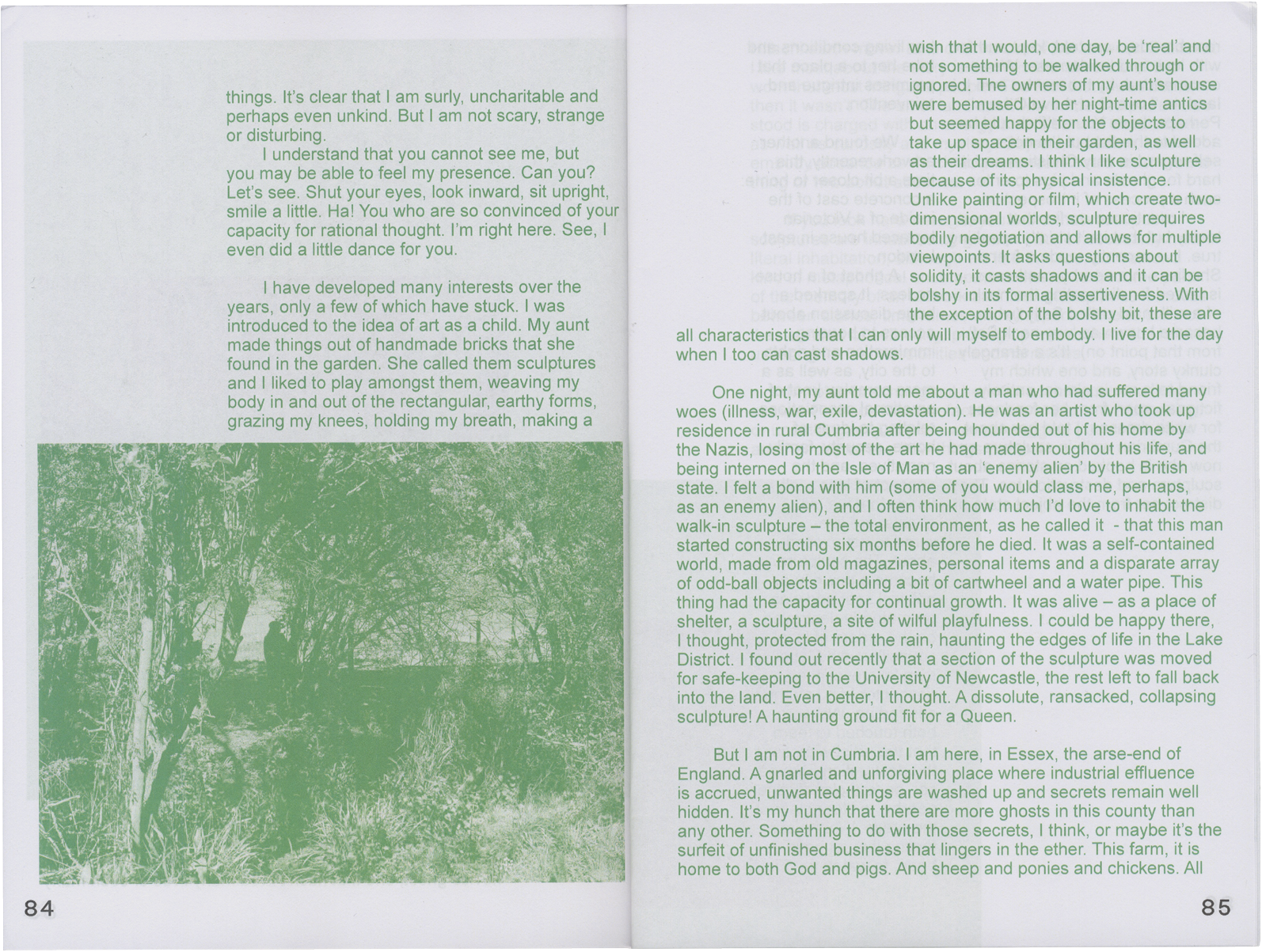
I live in this place, this perforated shelter, this thing that is newly constructed. I am lonely but that is the way I like it. I am unsure how I arrived here but I have a sense that I am a novice ghost, one that hasn’t lived many lives or seen many things. It’s clear that I am surly, uncharitable and perhaps even unkind. But I am not scary, strange or disturbing.
I understand that you cannot see me, but you may be able to feel my presence. Can you? Let’s see. Shut your eyes, look inward, sit upright, smile a little. Ha! You who are so convinced of your capacity for rational thought. I’m right here. See, I even did a little dance for you.
I have developed many interests over the years, only a few of which have stuck. I was introduced to the idea of art as a child. My aunt made things out of handmade bricks that she found in the garden. She called them sculptures and I liked to play amongst them, weaving my body in and out of the rectangular, earthy forms, grazing my knees, holding my breath, making a wish that I would, one day, be ‘real’ and not something to be walked through or ignored. The owners of my aunt’s house were bemused by her night-time antics but seemed happy for the objects to take up space in their garden, as well as their dreams. I think I like sculpture because of its physical insistence. Unlike painting or film, which create two-dimensional worlds, sculpture requires bodily negotiation and allows for multiple viewpoints. It asks questions about solidity, it casts shadows and it can be bolshy in its formal assertiveness. With the exception of the bolshy bit, these are all characteristics that I can only will myself to embody. I live for the day when I too can cast shadows.
One night, my aunt told me about a man who had suffered many woes (illness, war, exile, devastation). He was an artist who took up residence in rural Cumbria after being hounded out of his home by the Nazis, losing most of the art he had made throughout his life, and being interned on the Isle of Man as an ‘enemy alien’ by the British state. I felt a bond with him (some of you would class me, perhaps, as an enemy alien), and I often think how much I’d love to inhabit the walk-in sculpture – the total environment, as he called it- that this man started constructing six months before he died. It was a self-contained world, made from old magazines, personal items and a disparate array of odd-ball objects including a bit of cartwheel and a water pipe. This thing had the capacity for continual growth. It was alive – as a place of shelter, a sculpture, a site of wilful playfulness. I could be happy there, I thought, protected from the rain, haunting the edges of life in the Lake District. I found out recently that a section of the sculpture was moved for safe-keeping to the University of Newcastle, the rest left to fall back into the land. Even better, I thought. A dissolute, ransacked, collapsing sculpture! A haunting ground fit for a Queen.
But I am not in Cumbria. I am here, in Essex, the arse-end of England. A gnarled and unforgiving place where industrial effluence is accrued, unwanted things are washed up and secrets remain well hidden. It’s my hunch that there are more ghosts in this county than any other. Something to do with those secrets, I think, or maybe it’s the surfeit of unfinished business that lingers in the ether. This farm, it is home to both God and pigs. And sheep and ponies and chickens. All rare breeds, I am told, kept and fed with love and tenderness. We are commanded, by those who own this land, to ‘Love God, Love Others’. Perhaps ‘Love Yourself’ should be added to this list but I’m not sure self-regard is very Christian and it’s hard for ghosts and pigs to enter such a process of introspection.
I mentioned earlier that I was lonely but that isn’t strictly speaking true. I’ve recently made a friend. She lives in a nearby castle and is famed for dislocating the neck of a milkmaid called Sally (who became known as ‘wry-neck Sal’ from that point on). It’s a strangely clunky story, and one which my friend tells me is almost entirely fictional, apart from her fondness for white dresses. I told her about the Cumbrian walk-in sculpture and now she is hooked on stories about sculpture and destruction too. They distract her from the abject state of her living conditions and take her to a place that promises intrigue and reinvention.
We found another artwork recently, this time a bit closer to home: a concrete cast of the inside of a Victorian terraced house in east London. A ghost of a house no less. It sparked a huge discussion about access to housing, immigration and rights to the city, as well as a more complex knot of emotional associations relating to ideas of home, security, family narratives, and the concept of loss- all things that we, as ghosts, are live-wired to get excited about. The sculpture became a pawn in a political spat and was prematurely destroyed on the orders of local councillors who labelled it an ‘excrescence’, a descriptor I find strangely comforting. We were both touched to learn that the artist witnessed the destruction from her car, parked clandestinely nearby, to steer clear of the press. What a surreal feeling it must have been, to watch the Fiat Hitachi earth-mover take chunks out of her artwork. But what I like most about the story is that it is the absence of the work that most intrigues people. The fact that it was there, then it wasn’t. The bit of land upon which the sculpture once stood is charged with an energy that is born of destruction, as well as curiosity and mystery. Objects, it seems, can embody absence as much as presence. I could teach you a thing or two about absence.
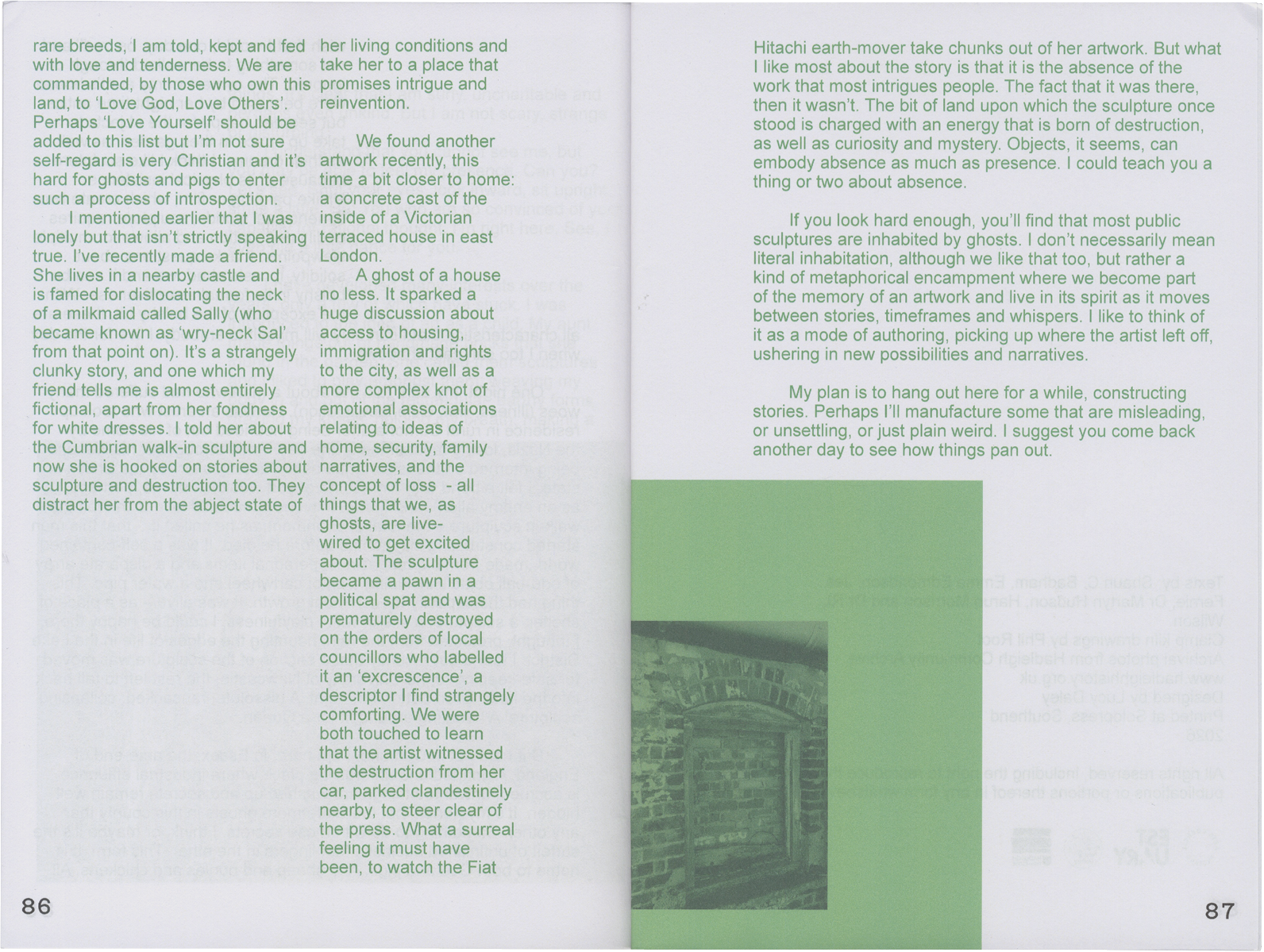
If you look hard enough, you’ll find that most public sculptures are inhabited by ghosts. I don’t necessarily mean literal inhabitation, although we like that too, but rather a kind of metaphorical encampment where we become part of the memory of an artwork and live in its spirit as it moves between stories, timeframes and whispers. I like to think of it as a mode of authoring, picking up where the artist left off, ushering in new possibilities and narratives.
My plan is to hang out here for a while, constructing stories. Perhaps I’ll manufacture some that are misleading, or unsettling, or just plain weird. I suggest you come back another day to see how things pan out.