Councillor Woodley Continues to be a Problem
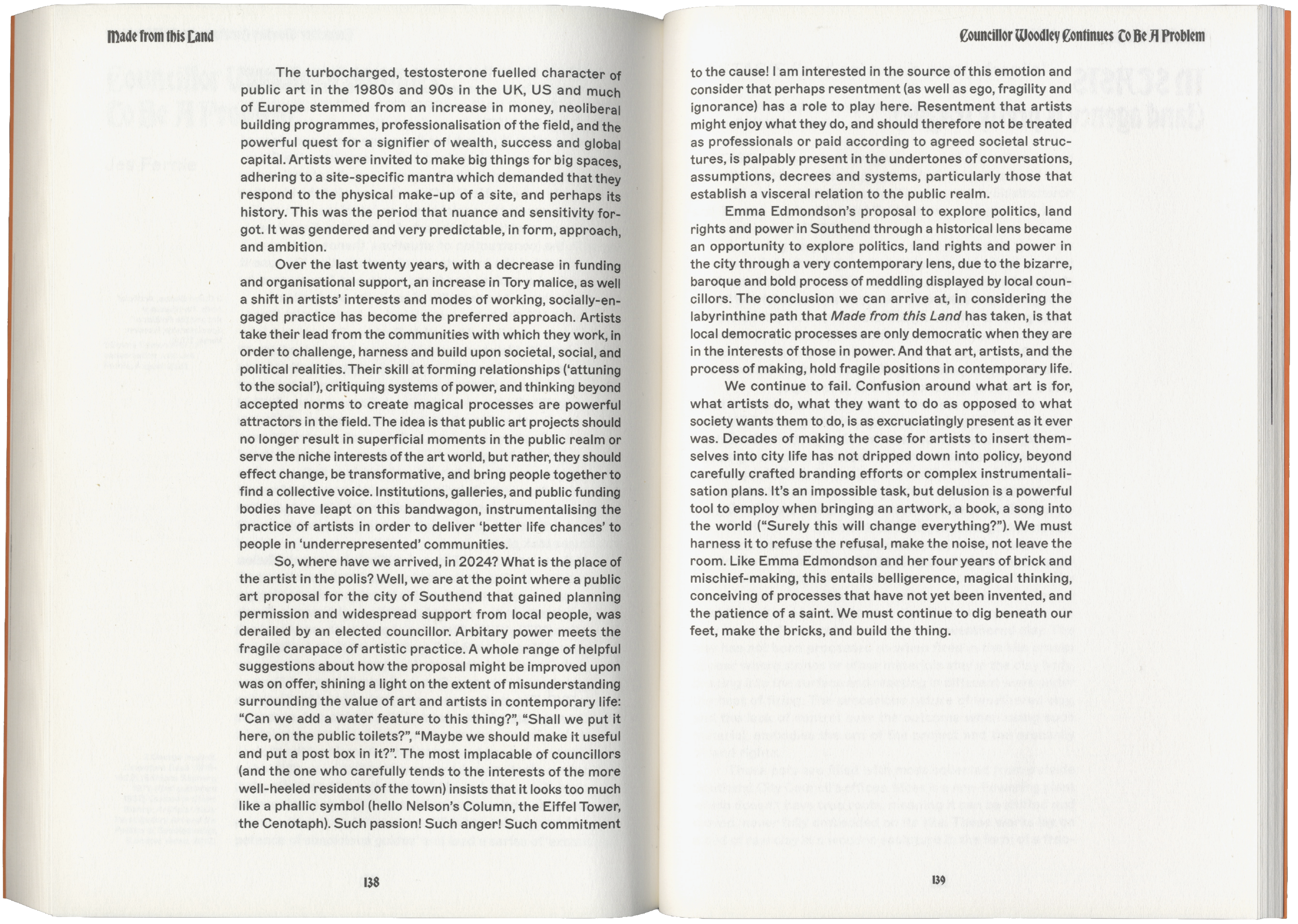
Artist Emma Edmondson invited me to write a text for her book Made From This Land, a collection of essays and stories that document and contextualise Emma’s series of permanent art commissions for Southend-on-Sea. I chose to write about the art commissioning process, providing historical context.
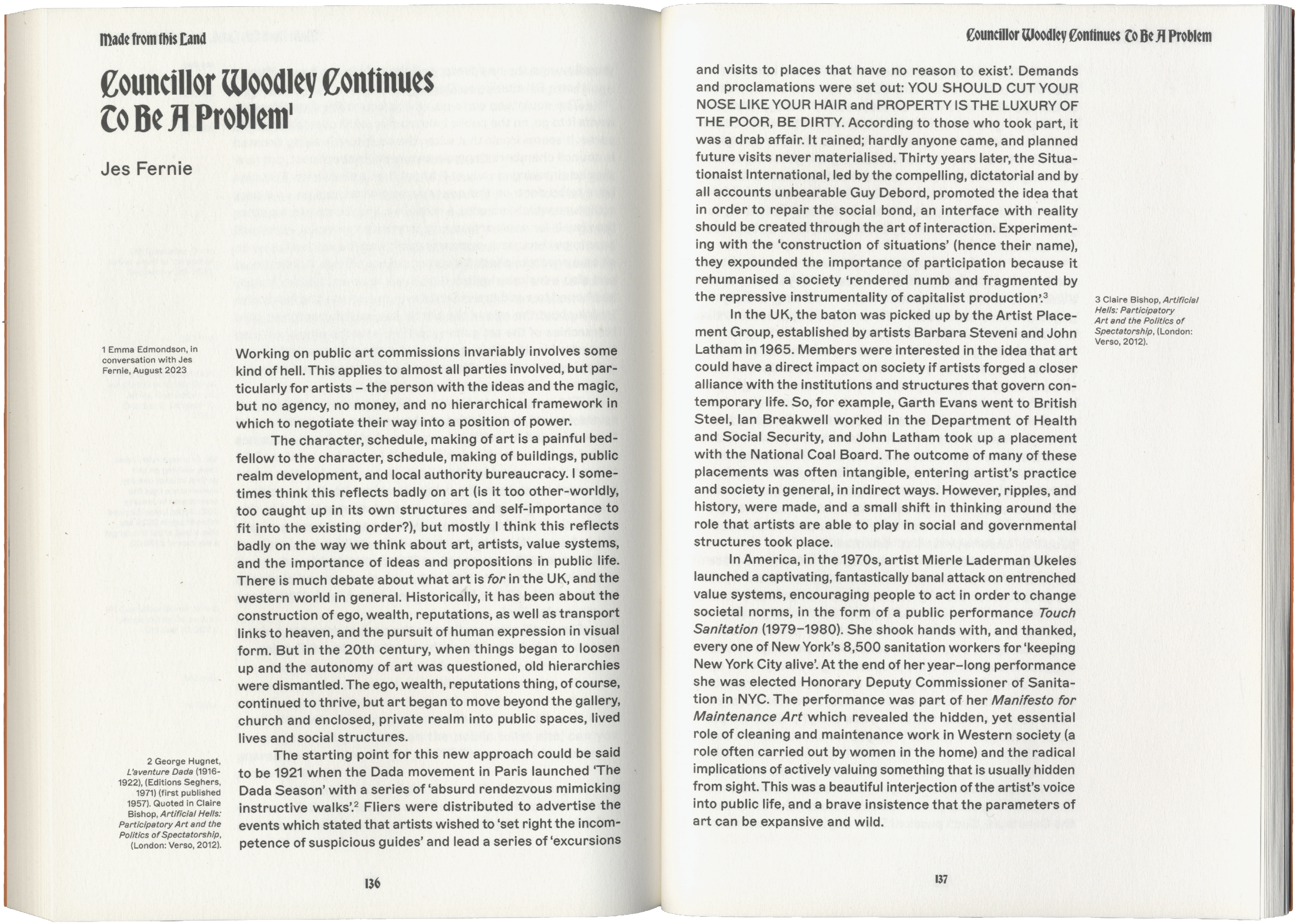
Working on public art commissions invariably involves some kind of hell. This applies to almost all parties involved, but particularly for artists - the person with the ideas and the magic, but no agency, no money, and no hierarchical framework in which to negotiate their way into a position of power.
The character, schedule, making of art is a painful bedfellow to the character, schedule, making of buildings, public realm development, and local authority bureaucracy. I sometimes think this reflects badly on art (is it too other-worldly, too caught up in its own structures and self-importance to fit into the existing order?), but mostly I think this reflects badly on the way we think about art, artists, value systems, and the importance of ideas and propositions in public life. There is much debate about what art is for in the UK, and the western world in general. Historically, it has been about the construction of ego, wealth, reputations, as well as transport links to heaven, and the pursuit of human expression in visual form. But in the 20th century, when things began to loosen up and the autonomy of art was questioned, old hierarchies were dismantled. The ego, wealth, reputations thing, of course, continued to thrive, but art began to move beyond the gallery, church and enclosed, private realm into public spaces, lived lives and social structures.
The starting point for this new approach could be said to be 1921 when the Dada movement in Paris launched ‘The Dada Season’ with a series of ‘absurd rendezvous mimicking instructive walks’. Fliers were distributed to advertise the events which stated that artists wished to ‘set right the incompetence of suspicious guides’ and lead a series of ‘excursions and visits to places that have no reason to exist’. Demands and proclamations were set out: YOU SHOULD CUT YOUR NOSE LIKE YOUR HAIR and PROPERTY IS THE LUXURY OF THE POOR, BE DIRTY. According to those who took part, it was a drab affair. It rained; hardly anyone came, and planned future visits never materialised. Thirty years later, the Situationalist International, led by the compelling, dictatorial and by all accounts unbearable Guy Debord, promoted the idea that in order to repair the social bond, an interface with reality should be created through the art of interaction. Experimenting with the ‘construction of situations’ (hence their name), they expounded the importance of participation because it rehumanised a society ‘rendered numb and fragmented by the repressive instrumentality of capitalist production'.
In the UK, the baton was picked up by the Artist Placement Group, established by artists Barbara Steveni and John Latham in 1965. Members were interested in the idea that art could have a direct impact on society if artists forged a closer alliance with the institutions and structures that govern contemporary life. So, for example, Garth Evans went to British Steel, Ian Breakwell worked in the Department of Health and Social Security, and John Latham took up a placement with the National Coal Board. The outcome of many of these placements was often intangible, entering artist’s practice and society in general, in indirect ways. However, ripples, and history, were made, and a small shift in thinking around the role that artists are able to play in social and governmental structures took place.
In America, in the 1970s, artist Mierle Laderman Ukeles launched a captivating, fantastically banal attack on entrenched value systems, encouraging people to act in order to change societal norms, in the form of a public performance Touch Sanitation (1979–1980). She shook hands with, and thanked, every one of New York’s 8,500 sanitation workers for ‘keeping New York City alive’. At the end of her year–long performance she was elected Honorary Deputy Commissioner of Sanitation in NYC. The performance was part of her Manifesto for Maintenance Art which revealed the hidden, yet essential role of cleaning and maintenance work in Western society (a role often carried out by women in the home) and the radical implications of actively valuing something that is usually hidden from sight. This was a beautiful interjection of the artist’s voice into public life, and a brave insistence that the parameters of art can be expansive and wild.
The turbocharged, testosterone fuelled character of public art in the 1980s and 90s in the UK, US and much of Europe stemmed from an increase in money, neoliberal building programmes, professionalisation of the field, and the powerful quest for a signifier of wealth, success and global capital. Artists were invited to make big things for big spaces, adhering to a site-specific mantra which demanded that they respond to the physical make-up of a site, and perhaps its history. This was the period that nuance and sensitivity forgot. It was gendered and very predictable, in form, approach, and ambition.
Over the last twenty years, with a decrease in funding and organisational support, an increase in Tory malice, as well as a shift in artists’ interests and modes of working, socially-engaged practice has become the preferred approach. Artists take their lead from the communities with which they work, in order to challenge, harness and build upon societal, social, and political realities. Their skill at forming relationships (‘attuning to the social’), critiquing systems of power, and thinking beyond accepted norms to create magical processes are powerful attractors in the field. The idea is that public art projects should no longer result in superficial moments in the public realm or serve the niche interests of the art world, but rather, they should effect change, be transformative, and bring people together to find a collective voice. Institutions, galleries, and public funding bodies have leapt on this bandwagon, instrumentalising the practice of artists in order to deliver ‘better life chances’ to people in ‘underrepresented’ communities.
So, where have we arrived, in 2024? What is the place of the artist in the polis? Well, we are at the point where a public art proposal for the city of Southend that gained planning permission and widespread support from local people, was derailed by illegal practices employed by an elected councillor. The abuse of power meets the fragile carapace of artistic practice. A whole range of helpful suggestions about how the proposal might be improved upon was on offer, shining a light on the extent of misunderstanding surrounding the value of art and artists in contemporary life: “Can we add a water feature to this thing?”, “Shall we put it here, on the public toilets?”, “Maybe we should make it useful and put a post box in it?”. The most vengeful of councillors (and the one who carefully tends to the interests of the more well-heeled residents of the town) insists that it looks too much like a phallic symbol (hello Nelson’s Column, the Eiffel Tower, the Cenotaph). When that doesn’t work, he is caught on tape threatening to drive his car into the sculpture in order to destroy it. Such passion! Such anger! Such commitment to the cause! I am interested in the source of this emotion and consider that perhaps resentment (as well as ego, fragility and ignorance) has a role to play here. Resentment that artists might enjoy what they do, and should therefore not be treated as professionals or paid according to agreed societal structures, is palpably present in the undertones of conversations, assumptions, decrees and systems, particularly those that establish a visceral relation to the public realm.
Emma Edmondson’s proposal to explore politics, land rights and power in Southend through a historical lens became an opportunity to explore politics, land rights and power in the city through a very contemporary lens, due to the bizarre, baroque and bold process of meddling displayed by local councillors. The conclusion we can arrive at, in considering the labyrinthine path that MADE from this LAND has taken, is that local democratic processes are only democratic when they are in the interests of those in power. And that art, artists, and the process of making, hold fragile positions in contemporary life.
We continue to fail. Confusion around what art is for, what artists do, what they want to do as opposed to what society wants them to do, is as excruciatingly present as it ever was. Decades of making the case for artists to insert themselves into city life has not dripped down into policy, beyond carefully crafted branding efforts or complex instrumentalization plans. It’s an impossible task, but delusion is a powerful tool to employ when bringing an artwork, a book, a song into the world (“Surely this will change everything?”). We must harness it to refuse the refusal, make the noise, not leave the room. Like Emma Edmondson and her four years of brick and mischief-making, this entails belligerence, magical thinking, conceiving of processes that have not yet been invented, and the patience of a saint. We must continue to dig beneath our feet, make the bricks, and build the thing.