You Are Here
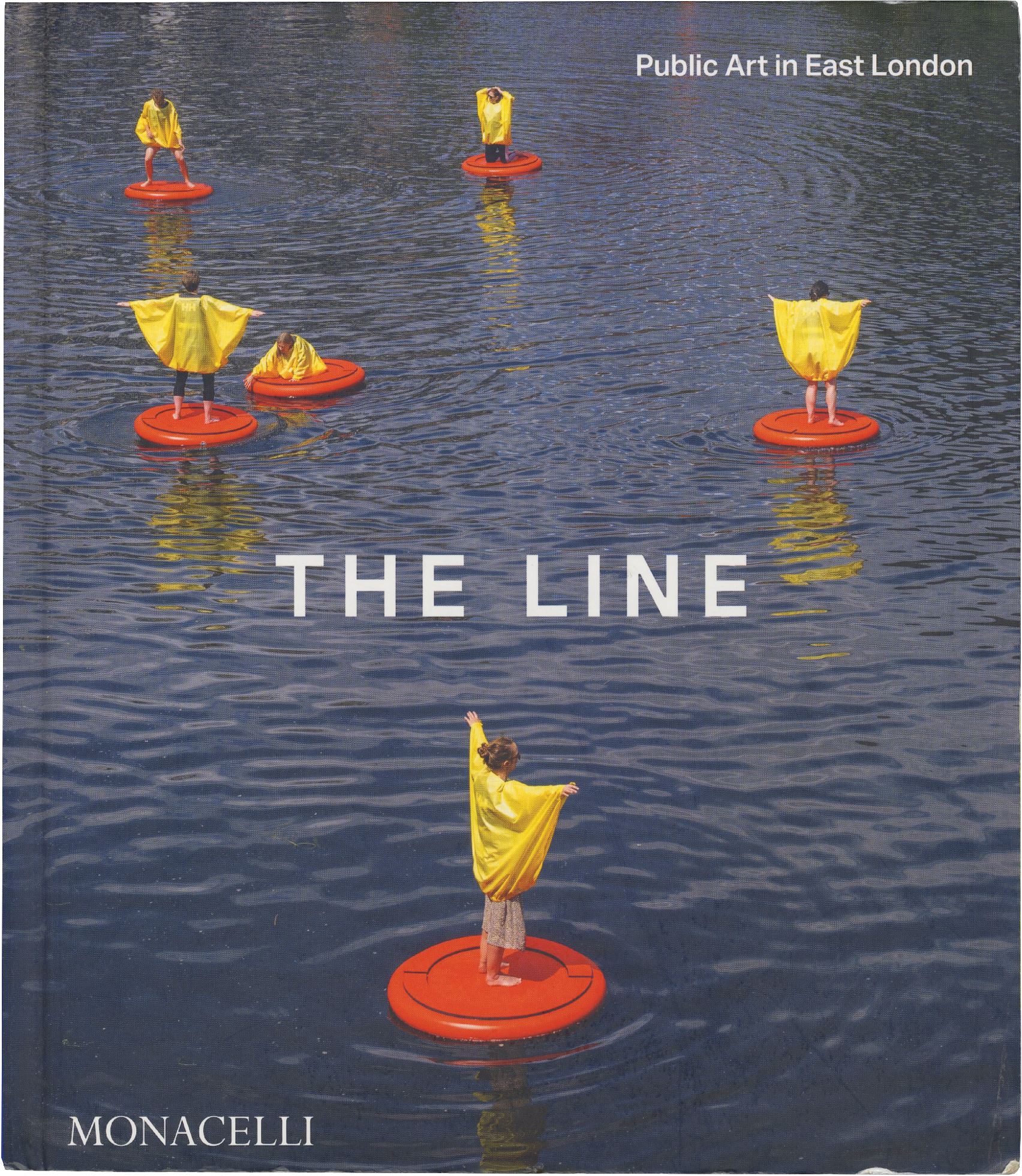
I loved writing this essay for a book celebrating the tenth anniversary of The Line, a public art route through feral east London. You Are here reflects on the art, the shadows, the history and our perfectly strange, muffled attempts to locate ourselves in the world.
The book was published by Phaidon Monacelli in 2025.
Let’s start here, where you are standing, sitting, looking, hunching, breathing. This is the beginning. Throw yourself into a crisp winter’s day at the end of the first quarter of the twenty-first century. It’s late afternoon, the sun casts enormous greedy shadows over the landscape around you. We are in North Greenwich, an area in east London that conjures images of majestic excess, ships, architectural grandeur and a dictatorial relationship to the constructs of time. You can see your breath ahead of you as you begin to walk towards the river, that bit that forms a magnificent ‘U’ and is framed by the Isle of Dogs, where Henry VIII kept his canine friends. To the east of here lies the truncated runway of London City Airport, from where the world stretches out ad infinitum. A black-headed gull squawks overhead, gliding towards a place that doesn’t involve you; a cyclist rushes past, smiling at something you can’t see. There’s the hum of industry: construction sites, cranes in motion, ventilation shafts, 21st century white noise - all folded into a rich, fraught history of ship building and dock work. A man wearing a lanyard appears on the other side of a fence; he looks like he’s dreaming, not working. There are closed ecosystems here that are self-sufficient and mute; but there are others that invite you in, pointing towards past and future possibilities and things unknown, posing questions, proposing answers, issuing provocations.
Some of these generous, open systems take the form of artworks, installed by the river, over the river, on the river, on railings, walkways, and buildings, from North Greenwich to Stratford. Together, they suggest ways of relating to the world, to ourselves, and things we have built up around us. I want to say that they, and the environment in which they sit, inspire a kind of epiphany, but that sounds too grand for an experience that insists that you are not the main actor.
At the top of a pole, on this walkway at the tip of Greenwich Peninsula, there’s an unprepossessing municipal road sign that reads Here 24,859. It is an artwork by Alison Craighead and Jon Thomson that locates you in space and informs you, in a beautifully concise manner, that if you were to fly around the earth to arrive back at yourself, you will have travelled 24,859 miles. I’m thinking of my daughter as a baby, crawling up the stairs for the first time, glancing back at me, grinning with toothless pride. I realised that I’d been conceiving of her life as a set of future possibilities (What will she become? How will she relate to the world?) and understood that she is what she is now, here, in this moment, and this is what matters. And here I am, twenty-four years later, thinking of it again, reflecting on our need to construct narratives using time and distance as tools to build our worlds and tether us to life.
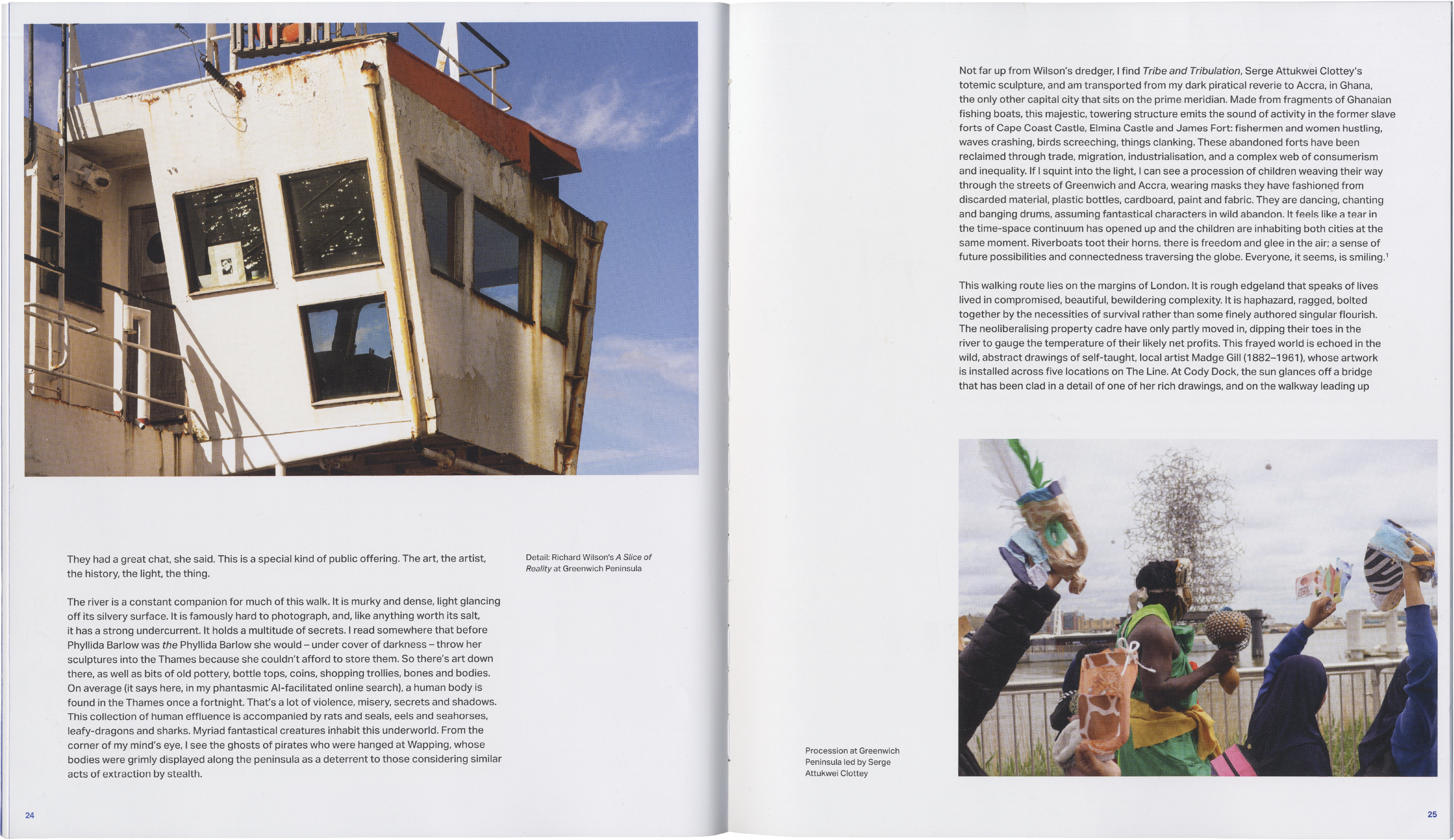
I walk on, my hands increasingly numb with cold, watching three men fix a puncture. They are in good spirits; their Lycra-clad bodies suggest that they aren’t in a hurry, there’s nothing important to get to. I come across a section of boat that has been bolted into the riverbed. Installed to celebrate the millennium twenty-five years ago, this is Richard Wilson’s sublime offering to the maritime gods, A Slice of Reality: an ocean sand dredger called the Arco Trent that he cut through to reveal the innards. I can see bits of ramshackle furniture, a faded album cover placed up against the window (is that the chiselled face of Feargal Sharkey surveying the water quality below?), and pipes that no longer provide a function beyond intrigue. This hulking great object that is so easy to miss unless you are told to see it, alludes to the violence of the Meridian line. Forged 140 years ago to prop up a universal understanding of time, it helps us cut across the specificities of cultures and lives with effortless indifference and criminal insensitivity. This artwork tethers us to a history of Empire that is both painful and significant. It is ageing alongside us and gets more ragged and complex every year. A friend messages to tell me that she called the mobile number posted on a hand-painted wooden plaque on the boat. The artist picked up. They had a great chat, she said. This is a special kind of public offering. The art, the artist, the history, the light, the thing.
The river is a constant companion for much of this walk. It is murky and dense, light glancing off its silvery surface. It is famously hard to photograph, and, like anything worth its salt, it has a strong undercurrent. It holds a multitude of secrets. I read somewhere that before Phyllida Barlow was PHYLLIDA BARLOW she would – under cover of darkness - throw her sculptures into the Thames because she couldn’t afford to store them. So there’s art down there, as well as bits of old pottery, bottle tops, coins, shopping trollies, bones and bodies. On average (it says here, in my phantasmic AI-facilitated online search), a human body is found in the Thames once a fortnight. That’s a lot of violence, misery, secrets and shadows. This collection of human effluence is accompanied by rats and seals, eels and seahorses, leafy-dragons and sharks. A myriad of fantastical creatures inhabit this underworld. From the corner of my mind’s eye, I see the ghosts of pirates who were hanged at Wapping, whose bodies were grimly displayed along the Peninsula as a deterrent to those considering similar acts of extraction by stealth.
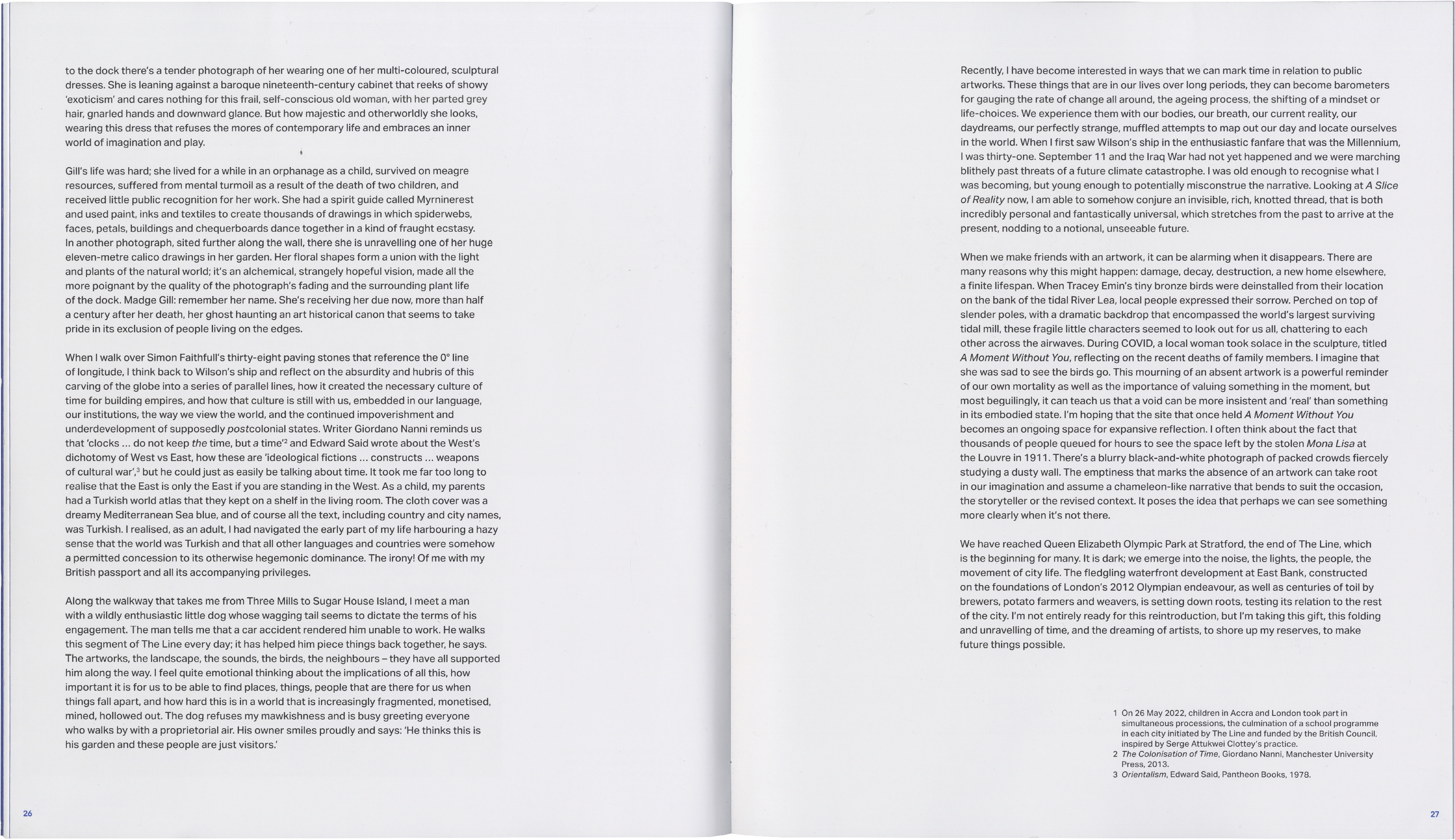
Not far up from Wilson’s dredger, I find Tribe and Tribulation, Serge Attukwei Clottey’s totemic sculpture and am transported from my dark piratical reverie to Accra, in Ghana, the only other capital city that sits on the prime meridian. Made from fragments of Ghanaian fishing boats, this majestic, towering structure emits the sound of activity in the former slave forts of Cape Coast Castle, Elmina Castle and James Fort: fishermen and women hustling, waves crashing, birds screeching, things clanking. These abandoned forts have been reclaimed through trade, migration, industrialisation and a complex web of consumerism and inequality. If I squint into the light, I can see a procession of children weaving their way through the streets of Greenwich and Accra, wearing masks they have fashioned from discarded material, plastic bottles, cardboard, paint and fabric. They are dancing, chanting and banging drums, assuming fantastical characters in wild abandon. It feels like a tear in the time-space continuum has opened up and the children are inhabiting both cities at the same moment. Riverboats toot their horns, there is freedom and glee in the air; a sense of future possibilities and connectedness traversing the globe. Everyone, it seems, is smiling.
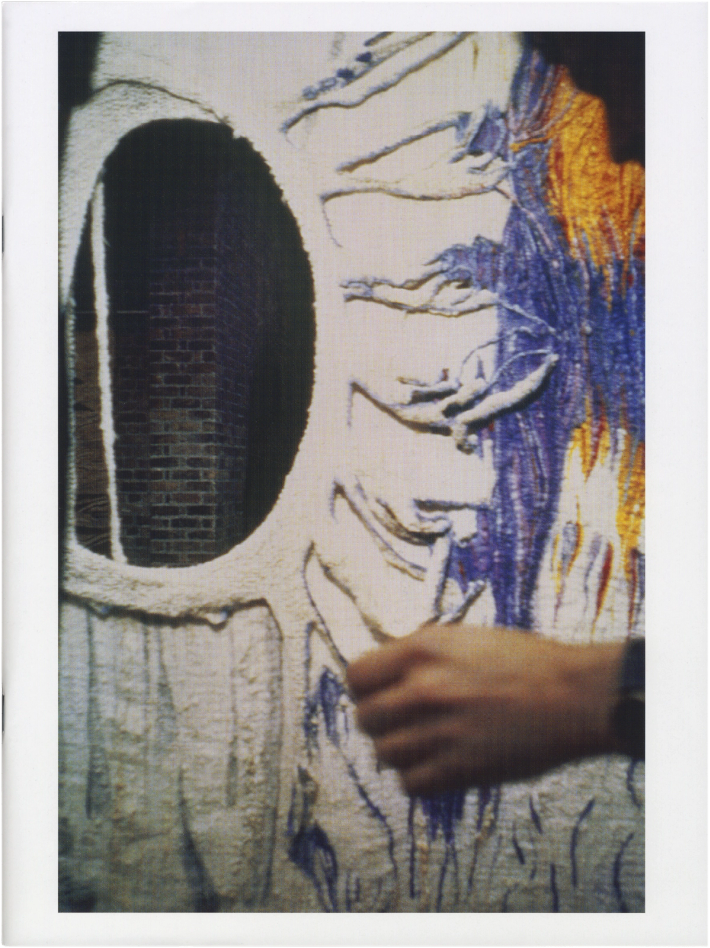
This walking route lies on the margins of London. It is rough edgeland that speaks of lived reality, lives lived in compromised, beautiful, bewildering complexity. It is haphazard, ragged, bolted together by the necessities of survival rather than some finely authored singular flourish. The neoliberalizing property cadre have only partly moved in, dipping their toes in the river to gauge the temperature of their likely net profits. This frayed world is echoed in the wild, abstract drawings of self-taught, local artist Madge Gill (1882 – 1961), whose artwork is installed across five locations on The Line. At Cody Dock, the sun glances off a bridge that has been clad in a detail of one of her fantastical drawings, and in the walkway leading up to the dock there’s a tender photograph of her wearing one of her multi-coloured, sculptural dresses. She is leaning against a baroque 19th century cabinet that reeks of showy ‘exoticism’ and cares nothing for this frail, self-conscious old woman, with her parted grey hair, gnarled hands and downward glance. But how majestic and other-worldly she looks, wearing this dress that refuses the mores of contemporary life and embraces an inner world of imagination and play.
Gill’s life was hard; she lived for a while in an orphanage as a child, survived on meagre resources, suffered from mental turmoil as a result of the death of two children, and received little public recognition for her work. She had a spirit guide called Myrninerest and used paint, inks and textiles to create thousands of drawings in which spiderwebs, faces, petals, buildings and chequerboards dance together in a kind of fraught ecstasy. In another photograph, sited further along the wall, there she is unravelling one of her huge eight-metre calico drawings in her garden. Her floral shapes form a union with the light and plants of the natural world; it’s an alchemic, strangely hopeful vision, made all the more poignant by the quality of the photograph’s fading and the surrounding plant life of the dock. Madge Gill: remember her name. She’s receiving her due now, more than half a century after her death, her ghost haunting an art historical canon that seems to take pride in its exclusion of people living on the edges.
When I walk over Simon Faithfull’s thirty-eight paving stones that reference the 0° line of longitude, I think back to Wilson’s boat and reflect on the absurdity and hubris of this carving of the globe into a series of parallel lines, how it created the necessary culture of time for building empires, and how that culture is still with us, embedded in our language, our institutions, the way we view the world, and the continued impoverishment and underdevelopment of supposedly ‘post’-colonized states. Writer Giordano Nanni reminds us that ‘clocks…do not keep the time, but a time’ and Edward Said wrote about the West’s West v. East, how these are ‘ideological fictions,…constructs...weapons of cultural war’, but he could just as easily be talking about time. It took me far too long to realise that the East is only the East if you are standing in the West. As a child, my parents had a Turkish world atlas that they kept on a shelf in the living room. The cloth cover was a dreamy mediterranean sea blue, and of course all the text, including country and city names, was Turkish. I realised, as an adult, I had navigated the early part of my life harbouring a hazy sense that the world was Turkish and that all other languages and countries were somehow a permitted concession to its otherwise hegemonic dominance. The irony! Me with my British passport and all its accompanying privileges.
Along the walkway that takes me from Three Mills to Sugar House Island, I meet a man with a wildly enthusiastic little dog whose wagging tail seems to dictate the terms of his engagement. The man tells me that a car accident rendered him unable to work. He walks this segment of The Line every day; it has helped him piece things back together, he says. The artworks, the landscape, the sounds, the birds, the neighbours - they have all supported him along the way. I feel quite emotional thinking about the implications of all this, how important it is for us to be able to find places, things, people that are there for us when things fall apart, and how hard this is in a world that is increasingly fragmented, monetised, mined, hollowed out. The dog refuses my mawkishness and is busy greeting everyone who walks by with a proprietorial air. His owner smiles proudly and says: ‘He thinks this is his garden and these people are just visitors’.
Recently, I have become interested in ways that we can mark time in relation to public artworks. These things that are in our lives over long periods, they can become
barometers for gauging the rate of change all around, the ageing process, the shifting of a mindset or life-choices. We experience them with our bodies, our breath, our current reality, our daydreams, our perfectly strange, muffled attempts to map out our day and locate ourselves in the world. When I first saw Wilson’s boat in the enthusiastic fan-fare that was the millennium, I was thirty-one. 9/11 and the Iraq War had not yet happened and we were marching blithely past threats of a future climate catastrophe. I was old enough to recognise what I was becoming, but young enough to potentially misconstrue the narrative. Looking at A Slice of Reality now, I am able to somehow conjure an invisible, rich, knotted thread, that is both incredibly personal and fantastically universal, which stretches from the past to arrive at the present, nodding to a notional, unseeable future.
When we make friends with an artwork, it can be alarming when it disappears. There are many reasons why this might happen: damage, decay, destruction, a new home elsewhere, a finite lifespan. When Tracey Emin’s tiny bronze birds were deinstalled from their location on the bank of Three Mills River, local people expressed their sorrow. Perched on top of slender poles, with a dramatic backdrop that encompassed the world’s largest surviving tidal mill, these fragile little convinced characters seemed to look out for us all, chattering to each other across the airwaves. During Covid, a local woman took solace in the sculpture, reflecting on the recent deaths of family members. I imagine that she was sad to see the birds go. This mourning of an absent artwork is a powerful reminder of our own mortality as well as the importance of valuing something in the moment, but most beguilingly, it can teach us that a void can be more insistent and ‘real’ than something in its embodied state. I’m hoping that the site that once held A Moment Without You becomes an ongoing space for expansive reflection. I often think about the fact that thousands of people queued for hours to see the space left by the stolen Mona Lisa at the Louvre in 1911. There’s a blurry black and white photograph of packed crowds fiercely studying a dusty wall. The emptiness that marks the absence of an artwork can take root in our imagination and assume a chameleon-like narrative that bends to suit the occasion, the storyteller, or the revised context. It poses the idea that perhaps we can see something more clearly when it’s not there.
We have reached Queen Elizabeth Olympic Park at Stratford, the end of The Line, which is the beginning for many. It is dark; we emerge into the noise, the lights, the people, the movement of city life. The fledgling waterfront development at East Bank, constructed on the foundations of London’s 2012 sporting endeavour, as well as centuries of toil by brewers, potato farmers and weavers, is setting down roots, testing its relation to the rest of the city. I’m not entirely ready for this reintroduction, but I’m taking this gift, this folding and unravelling of time and the dreaming of artists, to shore up my reserves, to make future things possible.